
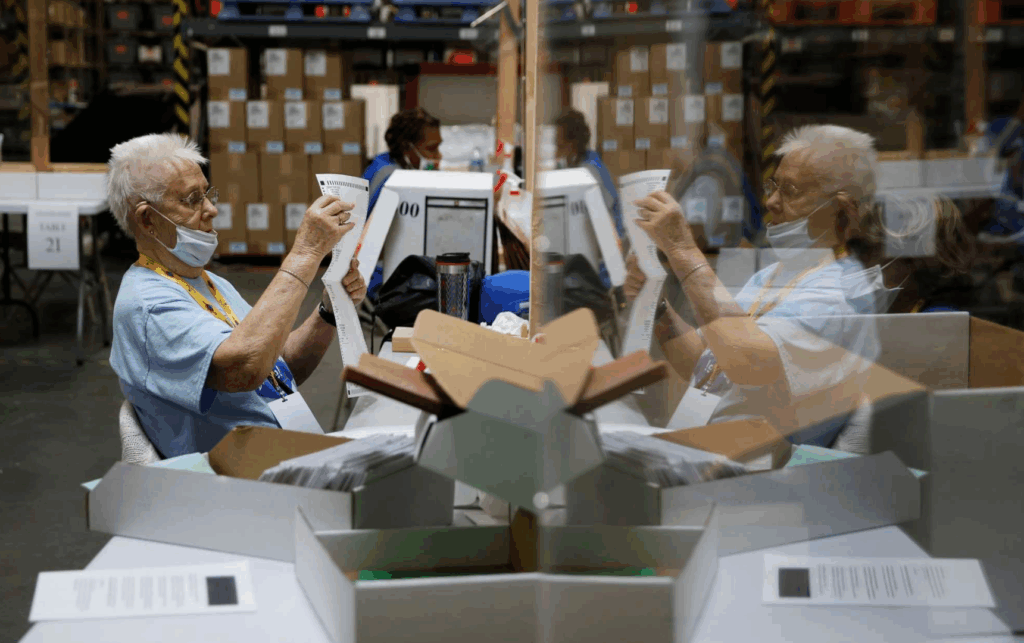
Tabatha Clemons was a county clerk in Grant County, Kentucky, for more than a decade. For the first half of her service, she loved it — when elections were just one part of her job.
“Elections in Kentucky were like a season,” she told Declare. “You prepare. The season comes and goes.”
And the rest of the time, you focus on your other duties. Clemons’s campaign website from 2018 offers several clues. For her reelection effort, she touted improved customer service for local registrations, access to county land records, and engagement with local schools and veterans.
Then 2020 hit. So much in America changed that year — including trust in elections, and the nature of administrators’ jobs to try to maintain it.
“Since 2020, it is a demanding full-time role to respond to false information, open records requests and lawsuits,” Clemons continued. “While I encourage citizens to question processes, there is no reason clerks should have to deal with threats, swatting and increased vigilance to ensure our elections remain fair, safe, accessible and free.”
She left her role for a private-sector opportunity in 2025, and did it “for many reasons,” she said. “[B]ut a major part of the decision was related to the stress and demands of being an election administrator.”
Emblematic, but not in the way you might think
Research from a partnership between the Bipartisan Policy Center and UCLA suggests that Clemons’s story could be representative of increased turnover in election administration. In 2004, for example, 28 percent of local chief election officials were new from four years prior. By 2022, that figure had grown to 39 percent. However, “Although significant, the upward trend is slow,” BPC stated in a report accompanying its data, and “[m]ost election officials continue to serve for more than four years.”
What is truly new is the radically changed job description of many local election officials, who, like Clemons, once administered elections as only one uncontroversial part of the whole role. In Michigan’s Ottawa County, Clerk Justin Roebuck has the resources to grow his team to accommodate the new spotlight on elections. But he knows that many counties, far smaller than the population of around 300,000 in his, don’t have those kinds of means. He compared the situation to the frog in the boiling water.
“When more and more gets added to these election administrators, there has to be a breaking point where, ‘enough is enough.’ ”
In Roebuck’s particular case, what was “already there,” in a sense, and what the public may not be aware of, is this list of duties:
- Recorder of deeds
- Issuance of vital records
- Birth Certificates
- Death Certificates
- Marriage licenses
- Clerk of County Board of Commissioners
And then there’s also elections.
“The pressure and the scrutiny have really only grown, I would say,” he told Declare.
Data Nerds to PR Specialists
Roebuck said he really remembers a shift even before 2020. It was 2016, when he was doing regular training of poll workers and fielding questions from would-be volunteers, including friends he had known for years. Questions like, “How do we know these absentee ballots are actually sent in from the voters?” and “Can we trust the count to be fair and accurate?” were raised.
“It was an eye-opening moment for me,” Roebuck said, “because this was a group of people who had done this work [before].”
But Roebuck admits the change really hit in 2020, when election officials went from “nerds of data to public relations specialists.”
“We have to understand how the public perceives what we’re talking about and how we can be good communicators of information that the general public might not be aware of,” he said.
That can include information that clerks weren’t even on the hook for previously. The mid-decade redistricting battles across the country provide an example. “From my four decades of working in elections, I can say every redistricting of any kind creates an administrative load, and the more fractured the [direction] from the General Assembly, the more exponentially troublesome it is to insure elections are administered accurately, fairly, smoothly and efficiently,” wrote Mike Smith, a longtime staff member with the Tippecanoe County Election Board in Indiana, to the state’s general assembly, as the newsletter Based in Lafayette reported.
Clemons said she “prays that the level of threats and stress clerks have endured will stop or we will continue to see turnover in election administration countrywide.” This isn’t a job to be taken lightly — for those who do it, as well as for the voters who rely on it to be done well.
“It is important to have experienced professionals in these important roles to ensure laws and regulations are followed and institutional knowledge doesn’t leave with them.”