
Donna Johnston lives in the relative peace of Sutter County in northern California, just above the state capital of Sacramento and in-between Tahoe and wine country. The mountains on the cusp of the county are a metaphor for the hurdles her fellow county election officials have faced since Covid: the ups and downs, rough terrain, and sometimes even rougher valleys. “I would just say that we’re very resilient and we’re very adaptable to change because things do change all the time, whether it be the Post Office, or legislatively or whatnot,” Johnston, Sutter County’s registrar of elections, told Declare.
In this case, change to the Post Office refers to a development that is shaking the elections landscape early in 2026. On Christmas Eve, the USPS finalized a rule that the agency summed up in a “myth/fact” document this way:
“[W]e have made adjustments to our transportation operations that will result in some mail pieces not arriving at our originating processing facilities on the same day that they are mailed. This means that the date on the postmarks applied at our processing facilities will not necessarily match the date on which the customer’s mail piece was collected by a letter carrier or dropped off at a retail location.”
The rule is intertwined with the Postal Service’s “Regional Transportation Optimization” initiative, which reduces mail carriers’ daily trips between rural Post Offices and regional processing centers from two to one. The agency claimed that a decline in first-class mail from 57 billion annual pieces to around 12 billion over the last 25 years made the second of the days’ trips a waste.
From a wide angle, it’s no big deal. Postmarks aren’t relevant to most of the “snail mail” that individuals and organized entities send daily. It’s when the mail arrives that matters.
From a narrow angle, though, it can matter when certain government mail is sent — like mail ballots.
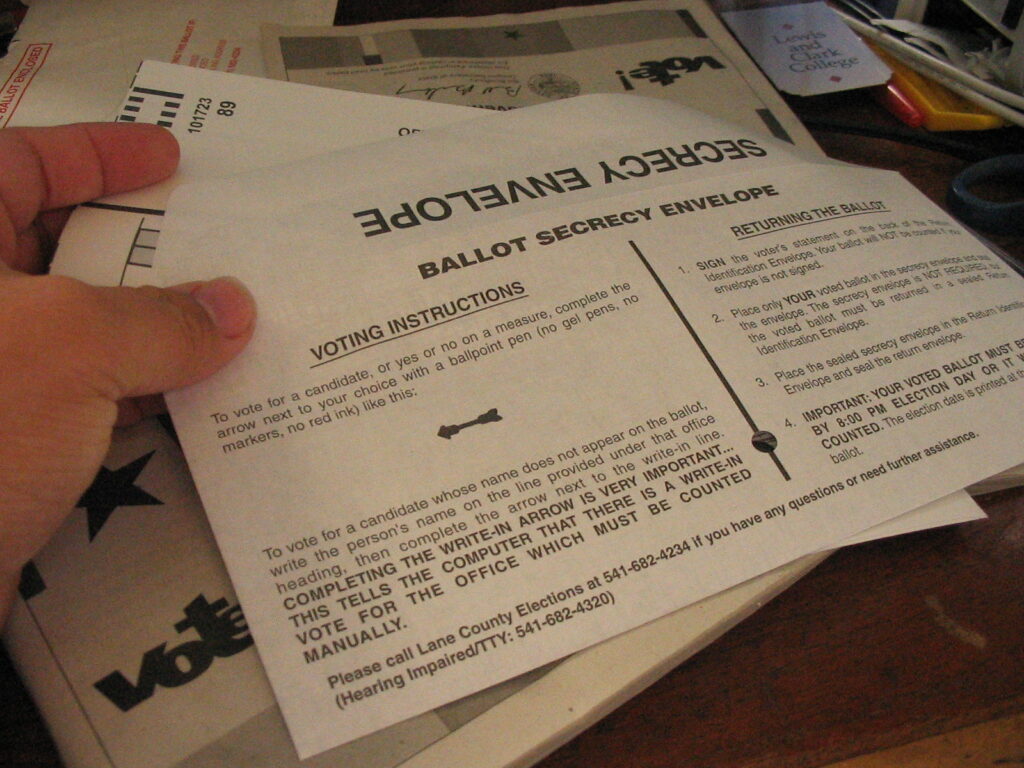
Fourteen states, including Johnston’s state of California, accept mail ballots that arrive after Election Day if they are postmarked on or before Election Day. With this new rule, there is concern about the status of such ballots sent last-minute, if they technically were “in the mail” by Election Day’s end but were not marked as such because of processing delays.
“In our county, we know that we can help facilitate getting the ballots back to us, timely. So, we’re always calling the Post Office: ‘Do you have any ballots for us?’ ” Johnston went on. “But I know that that’s not possible for all counties to be able to do, either staffing-wise, time-wise, or even [in terms of] coordination and cooperation from our local Post Office.”
To investigate her point, Declare contacted dozens of election officials that serve rural areas in the 14 states where the postmark rule could be an issue. Yet again, their profession could be singled out for a problem not of their own making. Are they concerned? And regardless, how are they responding, in some cases just two months away from primary election dates? Of those who responded, their reactions were generally a mix of appreciation for the professionalism of postal workers — and a spectrum of urgency to frustration for informing the public.
John Ackerman, a Republican and the election clerk of Tazewell County, Illinois, said he’s upset at USPS leadership for leaving him and his fellow clerks in the dark after they’ve spent years since the COVID pandemic building a solid and trustworthy foundation together. The communications they’ve received from constituents so far were enough for Ackerman to help plan a press conference at this week’s Illinois Association of County Clerks and Recorders conference, scheduled for Thursday (1/15). More than half of the state’s county clerks are expected to be at the conference itself.
“They (USPS) really took pride in their partnership on processing the vote-by-mail ballots. They worked closely with us. That’s changed now,” Ackerman told Declare. “They didn’t talk with us, communicate with us, about this change at all. They just delivered it. This will dramatically impact how vote by mail is done within the state of Illinois.”
Ackerman said that the USPS has given priority to election mail in the past, consistent with the agency’s “extraordinary measures” policy in recent presidential election years. But he’s concerned how the new rule will affect their follow-through in future elections.
“They told us they will only be going to Post Offices to grab the mail to take to these distribution centers once a day in the morning. What that means is, all ballots cast on Election Day will not be picked up and brought to a distribution facility. They will wait for the next day,” Ackerman said. “So, we had consistently communicated to the public that, if your ballot was in the mailbox, on Election Day, postmarked, because it was being postmarked then at the Post Office [on] Election Day, your vote will count. Not true. Ballots in a mailbox on Election Day will not be counted postmarked until at minimum the next day.”
The USPS contends that this is much ado about nothing. “Given that the present rulemaking (together with other educational outreach endeavors . . .) educates election officials about the information conveyed by postmarks and educates voters who choose to use the mail to vote that they can take certain measures if they need a postmark date that aligns with the date of mailing, it should contribute to a more effective use of the mail for their purposes,” the rule’s text reads. “Concerns that [the rule] may ‘disenfranchise’ voters and/or overtax the capacities of Boards of Elections are therefore misplaced.”
Scott Hoen, the Carson City Clerk-Recorder in Nevada and also a Republican, agrees that this change will impact education they’ve worked hard to push out to the public. “There will be an impact, and we must go out of our way to educate our community about the change,” he told Declare. “We are promoting an early return of ballots to make sure their ballot is accepted with the signature match and curing process if not. Returning ballots on Election Day may put their ballot at risk for verification purposes, too.”
But Hoen is quick to stop there. He said that his office continues to work well with the USPS. “We are fortunate to have a Post Office that goes out of their way to deliver ballots at the end of the day on Election Day.”
In a press release sent to Declare from The Oregon Association of County Clerks, President Derrin Robinson said they’ve always encouraged mailing in a ballot early — at least a week ahead of Election Day. The Association also noted the wide availability of drop boxes in their state, where, “even if it is not in your county, [your ballot] will be collected in time.” The USPS itself advised in its rule how mailers can receive manual postmarks in-person at a retail location, as well as Certificates of Mailing.
Stephen Richer, the former Maricopa County (Arizona) Recorder and an adjunct scholar at the libertarian CATO Institute, wrote that such extra attention to planning ahead was a good thing — and the rule, instead of creating problems, might actually encourage more promptness from mail voters. That could lead, in turn, to two benefits, one for public trust in the election process and another for election administrators.
“[T]he USPS rule change might lead to faster election results. If the USPS announcement encourages voters to return their mail ballots earlier, election officials can process the ballots sooner, and we can all get results faster. This could improve confidence in US elections,” he argued in a blog post. “The latest academic research finds that ‘longer-than-expected vote counting time induces a large, significant decrease in trust in the election.’ “
Additionally, “the USPS announcement could incrementally improve the lives of election administrators. Nothing is worse than getting an avalanche of late-arriving ballots when people are already screaming at you for final results.”
Ackerman highlighted a different set of trust issues: those with his own constituents, who were educated to understand one deadline and now have to be informed of and act upon another.
“You really need to have your vote-by-mail ballot in the mail to us no later than a week before Election Day. And in such a dramatic change like that — that’s what erodes away the trust the public has,” he said. “ ‘Well, the rules were always changing. Why should I put any faith in this?’ And that’s harmful for us.”
The fallout of the rule comes amid a pending Supreme Court case to decide the constitutionality of state postmark statutes.
Regardless of perspective about the rule, a new flow of information is now required from election officials — and, in some cases, fast. The rule was made effective immediately, and Ackerman’s state of Illinois is one of the first on the 2026 primary calendar, with an Election Day of March 17, almost exactly two months from Thursday’s planned press conference. Texas (March 3) and Mississippi (March 10) are the other early-year primary-voting states with a postmark exception for mail ballots in their state statute.
California’s primaries aren’t until June 2. From the sounds of it, though, Johnston, the Sutter County registrar, would’ve been ready no matter what. She said she doesn’t think the public realizes the lengths both her local mail carriers and election workers go to, to make sure votes are counted. “I want to make sure that everybody has an option to vote however they want to vote, when they want to vote. So, I feel it’s more incumbent on me to try to navigate through that instead of trying to dictate when somebody should be voting, you know, or how they should be voting in person or by vote by mail.”
Chris Deaton contributed reporting.