
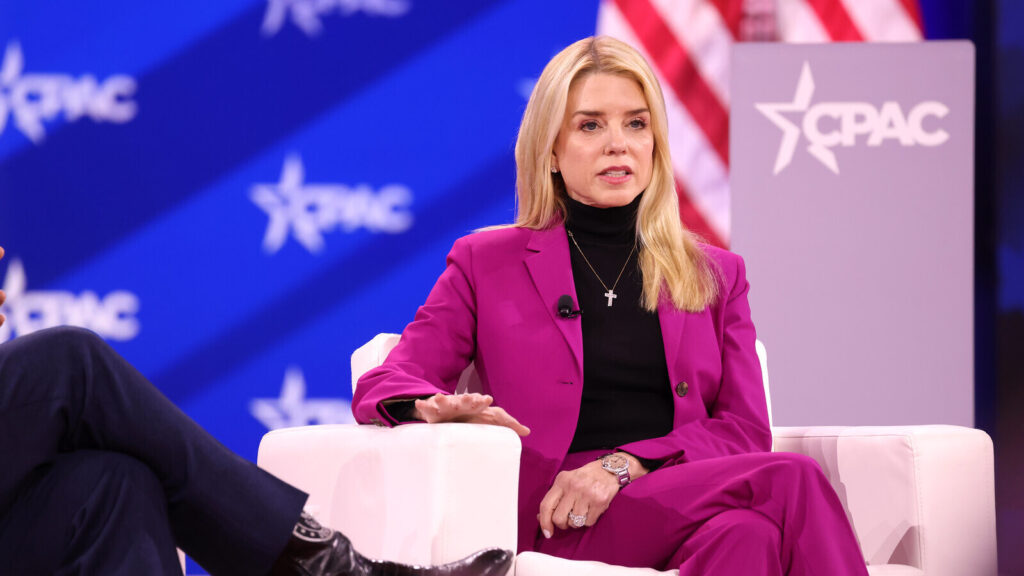
After the fatal shootings of two American citizens this month by federal law enforcement sent to Minneapolis as part of Operation Metro Surge, U.S. Attorney General Pam Bondi wrote to Minnesota’s governor in a letter dated Saturday that named a request for the state’s voter-roll data as part of the solution to the recent “chaos” there.
“You and your office must restore the rule of law, support ICE officers, and bring an end to the chaos in Minnesota,” Bondi wrote Gov. Tim Walz. “Fortunately, there are common sense solutions to these problems that I hope we can accomplish together.”
In addition to requesting state data about food benefit programs and the transfer of suspected illegal aliens in state custody to the federal government, Bondi reiterated that her department be granted access to the state’s voter rolls “to confirm that Minnesota’s voter registration practices comply with federal law.” The Trump administration and Minnesota are entangled in litigation about the issue, along with nearly two dozen other states.
“Fulfilling this common sense request will better guarantee free and fair elections and boost confidence in the rule of law,” Bondi continued. NBC News first reported the existence of the letter.
The mention of Medicaid and Food and Nutrition Service programs is tied to widespread and, in some cases, several-years-long fraud in Minnesota, amounting to hundreds of millions of dollars across multiple programs supported with federal money. (The libertarian Cato Institute compiled a resource-rich summary of the topic.) The second matter, of Minnesota’s alleged stubbornness in transferring suspected illegal immigrants to federal custody, was disputed by the state’s top corrections official, who told CBS News that “we need them to stop telling stories that are simply not true: that we will and do coordinate on the transfer of custody of people who are subject to ICE detainers, and will continue to do that, period.”
Framing these together with election-related issues, however, as a way to stabilize the turmoil in Minnesota, has implications for federalism and the credibility of the DOJ voter-roll requests as being about election integrity.
Almost every state has received such a request from the department, which includes a demand for each “registrant’s full name, date of birth, residential address, his or her state driver’s license number or the last four digits of the registrant’s social security number,” according to court filings. Nearly two dozen, including Minnesota, have been sued for failure to comply fully; Georgia’s secretary of state, for example, provided data that redacted sensitive information, and California’s offered DOJ the opportunity to inspect redacted data on-site in Sacramento.
Federal district judges in Georgia and California have tossed each of those suits, the former for lacking jurisdiction and the latter on the merits — mainly, that DOJ has the relevant power under the Civil Rights Act (CRA) of 1960 to compel the information, to ensure compliance with basic standards for voter list maintenance named in federal election law. The judge in the California case rejected that argument, noting that the relevant election statute, the Help America Vote Act, was enacted many decades after the CRA, and that the government’s particular request in relation to it was up to Congress.
“Should Congress want to enable the Executive to centralize the private information of all Americans within the Executive Branch, Congress will have to clearly say so,” wrote U.S. District Judge David Carter.
Minnesota had not provided any of its data prior to being sued in September, following a request from Secretary of State Steve Simon’s office asking how the federal government planned to handle it. Simon used the words “disturbing,” “bizarre,” and “puzzling” to describe Bondi’s letter during an interview with CNN on Sunday evening; he called it “an outrageous attempt to coerce Minnesota” in a statement released earlier in the day. Shenna Bellows, the Maine secretary of state, released a similar comment.
Bondi’s letter immediately became an issue in separate litigation concerning Minnesota on Monday, between the state and the federal government over the legality of the federal law enforcement surge in the state. “They’re trying to get us to turn over voter rolls. What does that have to do [with immigration]?” a lawyer for the state said during a hearing, Politico reported. The Trump administration’s lawyer argued that the state’s arguments “would turn federalism on its head” — a latest instance of a traditionally “conservative” concept being up for grabs, as Democratic-led states tangle with a Republican president.
Oklahoma governor Kevin Stitt, himself a Republican and chairman of the National Governors Association, led a statement with his Democratic counterpart, vice chairman Wes Moore of Maryland, in advocating for a federal approach “that complements — rather than supplants — state and local efforts to uphold the law.”
“America’s strength has long rested on a system of cooperative federalism,” Stitt and Moore said. “Governors are closest to conditions on the ground and are best positioned to respond to challenges within their states and territories, particularly those involving public safety. At the same time, moments of national strain require clear leadership, shared purpose, and coordination across all levels of government.”