

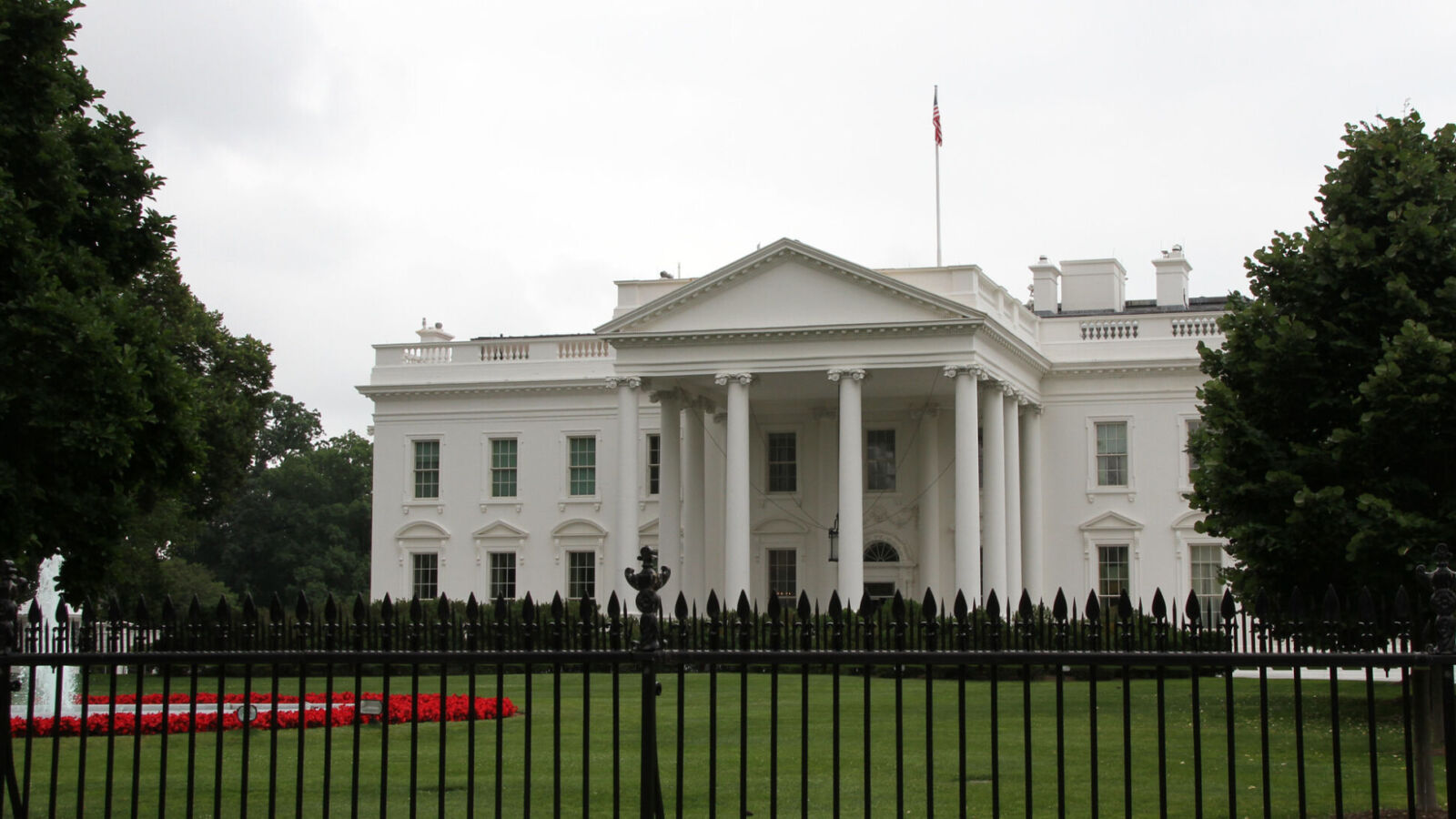
President Trump signed an executive order on Tuesday with the dual purpose to “assist in verifying identity and Federal election voter eligibility” and “enhance election integrity via the United States Mail.” The details of it, however, are prompting skepticism from some conservatives, who question how the order fits with states’ authority over election administration and existing federal law, and whether it opens another door to further consolidation of power in the executive branch — on elections or other issues for which a national database of information about individual Americans is an essential tool.
For the “voter eligibility” portion, the order requires the Department of Homeland Security to “compile and transmit to the chief election official of each [s]tate” a list of eligible voters at least 60 days before each federal election. It then directs the Attorney General to “prioritize” the investigation of any instances of election officials who issue ballots to anyone not on the list, as well as of “public or private entities engaged in, or aiding and abetting, the printing, production, shipment, or distribution of ballots” to ineligible voters. Separately, the mail ballot part of the order directs the USPS to create and distribute similar, state-specific lists for mail-ballot-eligible voters, and “not transmit mail-in or absentee ballots from any individual” whose name isn’t on such lists.
Under the president’s decree, the executive branch may withhold federal funding to “noncompliant States and localities where such withholding is authorized by law.”
Conservative reaction
Kevin Kosar, a researcher and preeminent Postal Service expert at the American Enterprise Institute — a public policy organization on the right and frequent critic of the Obama and Biden administrations — shared several initial responses to the order on Wednesday. “This [executive order] would create a DHS registry of where every American citizen lives and compel Americans to notify the government to update their data every time they move — lest they lose the right to vote by mail,” one of them reads. “I wonder how many Americans are comfortable with that.”
He also wondered if multiple aspects of the order were beyond the executive branch’s reach — instead under the authority of the USPS’s board and regulations, and Congress and federal law — and if the federal bureaucracy, a frequent bugbear of conservatives for its inefficiency, was up to organizing all the work. “The executive order’s plan demands coordinated action by a few federal agencies and 50 state governments (and the District of Columbia). While not impossible, this is a tall order and will take a lot of leadership, time, and effort to execute,” he wrote. “History is replete with agencies being told to coordinate and then failing to do so competently.”
Ed Whelan, a former law clerk to the late Supreme Court Justice Antonin Scalia and a conservative legal advocate, produced a more pointed criticism. “It is impossible for states to ‘disobey’ an executive order,” he wrote on Wednesday morning, about the order’s threat of withholding state and local funding in response to noncompliance. “An executive order is a vehicle by which a president directs executive-branch officials how to administer existing law.
“Trump cannot ‘mandate’ how states administer their absentee-ballot laws.”
Researchers at the R Street Institute, Matt Germer and Chris McIsaac — who previously advised the Washington state legislature and Arizona governor, respectively — shared bigger-picture thoughts about Trump’s order. “Setting aside the legal questions, the order points down a troubling path,” they began: “if the federal government can condition the delivery of mail or compel state and local data in an election context, it is not hard to imagine a future administration using similar authority to restrict the delivery of other lawful but politically sensitive materials or to justify the creation of a federal registry built on state data.
“That kind of precedent would be difficult to contain.”
What election officials are saying
Several Democratic election officials across the country were quick to criticize the Trump order, including the secretaries of state of Arizona, Colorado, and Maine. Independent of those reactions, however, the chief election officials in New Hampshire and Utah, both Republicans, expressed a range of doubt to amusement in response.
“The Federal Government cannot usurp New Hampshire’s express constitutional authority to run elections and cannot compel New Hampshire to violate state and federal election statutes, including those that protect the privacy of voter information,” said David Scanlan, the New Hampshire Secretary of State, per the Boston Globe.
The lieutenant governor of Utah, Deidre Henderson, likened the executive order to a one-act play “full of nonsensical dialogue.”
Declare has spoken with local election officials who are doubtful that ambitious efforts from the federal government to crack down on noncitizen voter registration and voting are necessary, given the tiny scale of the issue as a matter of raw numbers. The Heritage Foundation’s election fraud map continues to show that proven instances of voter fraud are few and randomly distributed, dating back decades.
Taking Elections Seriously, with Gabriel Sterling and Stephen Richer