

Most voters favor state instead of federal management of elections by more than 2-to-1, a poll of an enormous cross section of the American electorate has found, as Congress, the Supreme Court, and even President Trump consider their own roles in the process this year.
The survey from DeepRoot Analytics sampled 4,975 registered voters across the country, with 36 percent comprising self-identified Republicans and Democrats each and 23 percent consisting of Independents, providing a balanced overview of opinions on a newly contentious set of issues this decade.
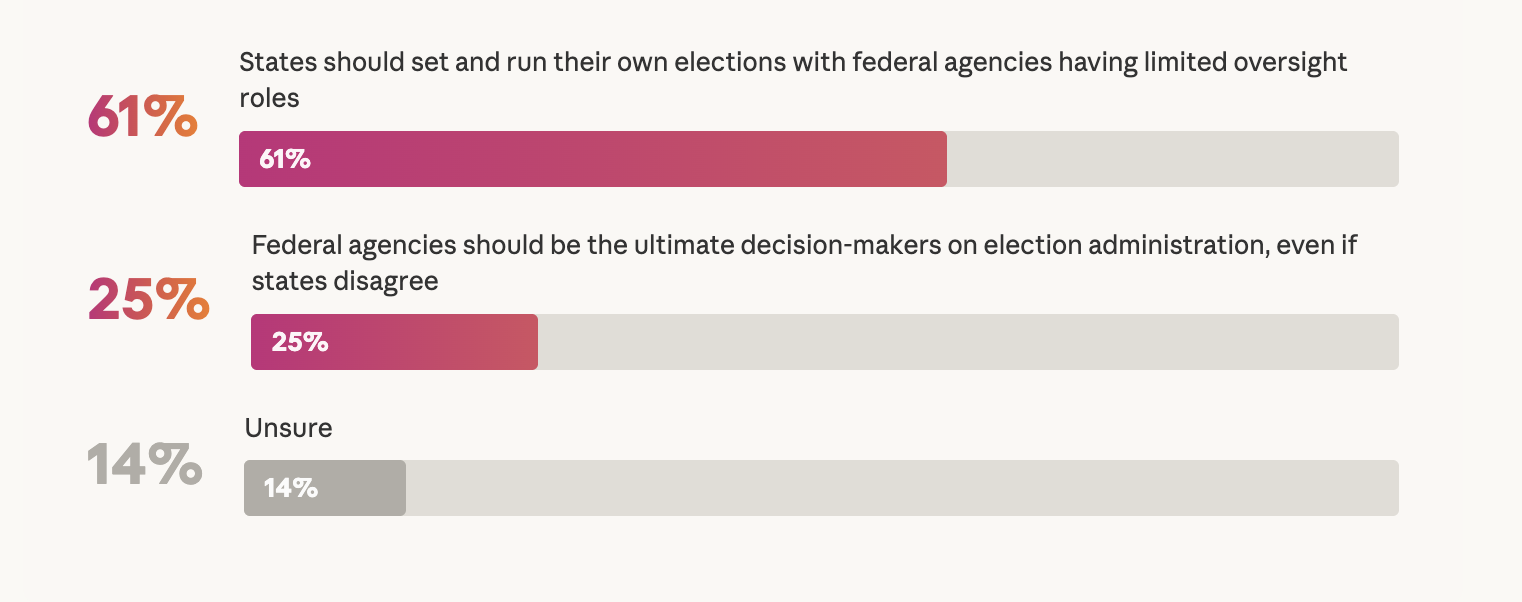
Sixty-one percent of respondents overall said the statement, “States should set and run their own elections with federal agencies having limited oversight roles,” came closer to their view than roughly the opposite: “Federal agencies should be the ultimate decision-makers on election administration, even if states disagree.” Just 25 percent favored the latter statement, and 14 percent said they were unsure.
Which level of government should be responsible for election administration has rarely been the most divisive of political questions. Just within the last year, however, President Trump has issued two executive orders on mail voting and noncitizen voting, and congressional Republicans have debated more lasting reforms with the SAVE Act and its stricter successor, the SAVE America Act. The Supreme Court recently heard arguments in a case about one of the mail voting topics targeted in Trump’s first executive order: the legality of state laws which allow late-arriving mail ballots to count as long as they were postmarked by Election Day.
All this activity has come in the broader context of the president’s insistence that he won the 2020 election and congressional Democrats’ own responses to that claim, such as the failed For the People Act, a federal attempt to codify certain expansions of voting methods and timelines.
Despite the divisions, most voters remain united in response to some key questions, the poll found. Seventy-seven percent said they were at least somewhat confident that votes would be cast and counted accurately in their state this coming November. Similarly, 77 percent said they at least somewhat trusted election technology in use in the overwhelming majority of election jurisdictions: namely, ballot scanners, which are used in places with both electronic printouts of ballots and hand-marked paper ballots. The exact same percentage said they somewhat trusted or strongly trusted electronic voting machines.
There are two types of electronic voting machines: “ballot marking devices,” which print a paper copy of a voter’s choices they can review before scanning it, and “direct recording electronic” machines, which actually record completed ballots electronically. In only all of Louisiana, some counties in Indiana, Ohio, and Tennessee, and a county each in Texas and Utah are these DREs in use. BMDs are far more common, for roughly 27 percent of registered voters nationwide.
Despite the widely shared confidence, most respondents also rated a number of election integrity concerns as a “somewhat serious” problem, including noncitizen voting (58 percent) and mail ballot fraud (63 percent). On a numbers basis, there is no evidence that either qualifies as a problem that comes close to affecting election winners for major office, although they happen at tiny rates. An even larger number in the survey, 72 percent, said that foreign interference in U.S. elections was a somewhat or very serious problem — a particular term that means more like tampering with election processes or campaign organizations, than trying to influence voters with information campaigns (“foreign influence”). The latter is common, while the former is not.
Perhaps unsurprisingly, the election integrity issue drawing the most concern, 80 percent, was, “Media or political actors spreading misleading information about elections.”
A PDF copy of the survey is here.
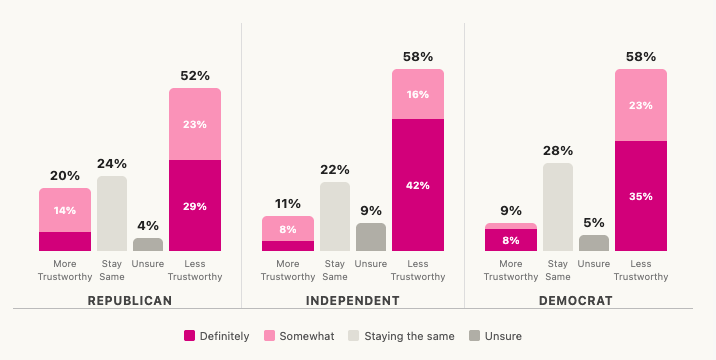 Cygnal · PennsylvaniaTo Pennsylvanians, Nation’s Elections Face Bipartisan Credibility Problem
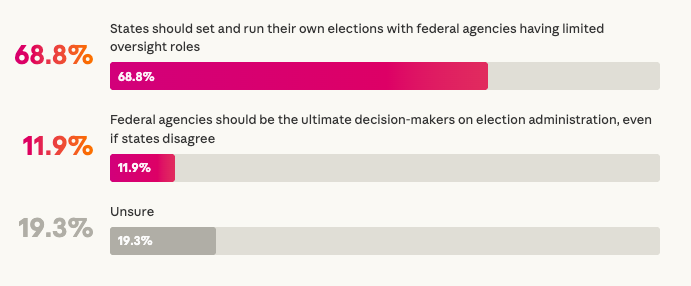 Opinion DiagnosticNC Republicans Favor State to Federal Election Control 63-18
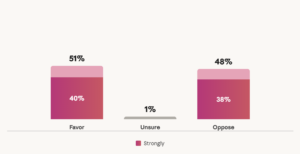 The Tarrance Group · NevadaNevada Voters 50/50 on Supreme Court Issue Argued This Week
 The Tarrance Group · Wisconsin78% of Wisconsinites Back ‘Pre-Processing’ of Mail Ballots
 Cygnal · ArizonaKnowing the Process Builds Trust in Arizona, Declare/Cygnal Poll Finds
 Cygnal · GeorgiaOnly 23 Percent of Republicans Support Full DOJ Voter Roll Request, Georgia Poll Finds