

No state’s election system has been denounced by the most partisan of Republicans and Democrats this decade more than Georgia’s. That the extent of it is unwarranted, which is provable from public opinion and more election audits than Hank Aaron has home runs, hasn’t calmed the rhetoric. President Trump lost the state in 2020 because of shaky-kneed election officials and Democrat-enabled fraud. Or wait — Georgia’s elections are conducted under Republican-backed “Jim Crow in the 21st century.” There is a verboten command in my household because it isn’t worded so nicely. But as Dr. McCoy from Star Trek said of an adversary who wouldn’t stop quoting Shakespeare, “I’d give real money if they’d shut up.”
Alas, no withdrawals from the piggy bank. An atmosphere so full of incredible accusations is bound to risk hasty or poorly planned responses from government officials — which, perhaps, is how the Peach State now confronts an actual, serious problem with its elections this year. It concerns the gap between some Republican legislators’ eagerness to reform how ballots are officially counted, and the necessary technology to make their wishes workable. Right now, it’s unbridgeable. The legislature, already adjourned for the year, has two months to build a way across, or else the legal system may have to find a path around.
In Georgia, voters make their selections on “ballot marking devices” — electronic machines made only for that purpose — which print off the completed paper ballots for them to review and feed into scanners for submission. Instead of scanning filled-in bubbles or candidates’ names, however, the scanners in Georgia count unique QR codes, which encode each voter’s full slate of choices. Here is a partial image of a ballot from the 2024 general election, for example.
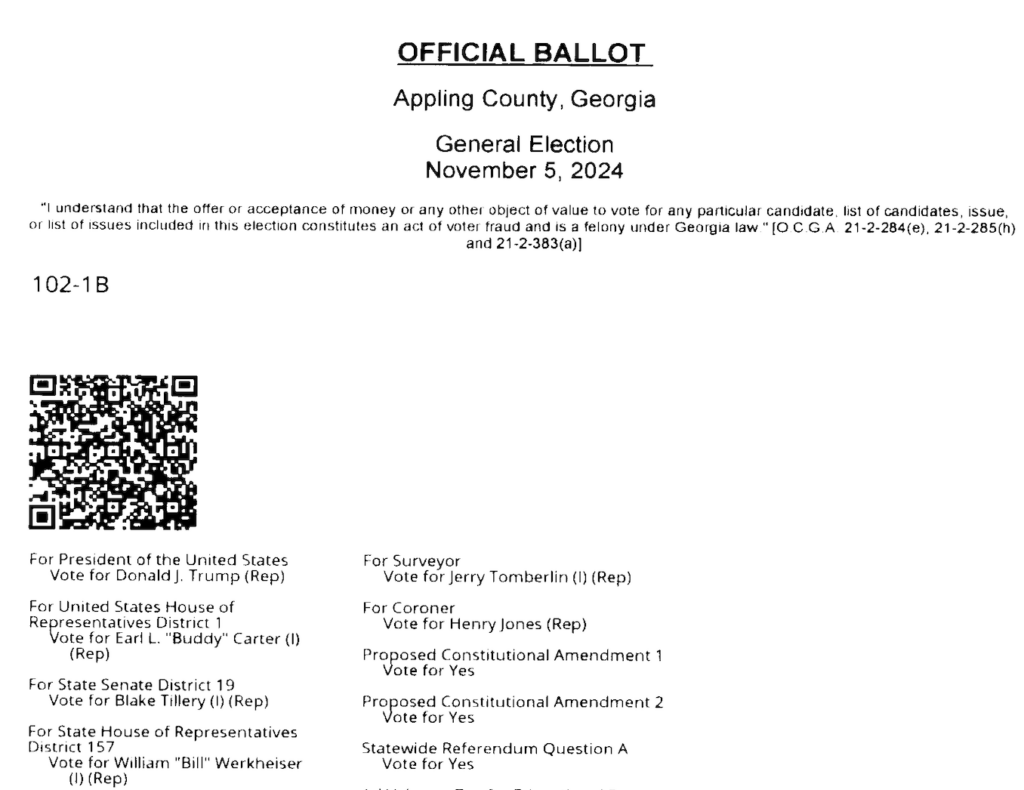
Some of the arguments for this approach are that it makes election administration more organized, requires the use of less paper, is encrypted and quite error-proof — and subject to numerous post-election reviews to provide the public and candidates with assurance about the accuracy of the results, anyway. But critics, such as Georgia state senator Max Burns, cite voters’ lack of trust in their individual selections being wrapped into a single code, instead of being read one-by-one. Even granting Burns’s side of the argument, the means for replacing QR code-counting would need to be realistic and provided in the first place. In the words of The Bard: Ay, there’s the rub.
Georgia enacted legislation in 2024, sponsored by Burns, to require that only “the text portion or machine mark” of a ballot — i.e., candidates’ names or bubbles filled in next to them — count as a vote, with an effective date of July 1 this year. What the bill did not consider, though, was . . . well, a lot. State law in place since 2019 requires all Georgia elections to be conducted with ballot marking devices and scanners, but the combination of the ones currently in use statewide literally cannot meet the 2024 law’s requirements. The ballot marking devices in service print ballots that include QR codes and the names of candidates chosen by a voter in each race, but not “marks” like fill-in bubbles. The scanners are equipped to read QR codes and marks like fill-in bubbles, but not the names of candidates chosen by a voter in each race. The only compatibility between ballot marking device and scanner is the QR code — the very type of vote the 2024 law bans in practice.
Because that law didn’t consider the mismatched technology, it didn’t create a process for altering it or replacing it. And that’s before the additional process of the legislature funding it.
Republican legislators can’t say they were caught off guard by this — not this year, at least. They did conduct a “blue ribbon” commission during the summer and fall months of 2025, which heard testimony across the state from a mishmash of current and former election officials and activists. County election administrators said consistently that SB 189, the 2024 law in question, was impracticable. The president of the state’s association of local election officials, Joseph Kirk, said that large-scale reforms such as 189 shouldn’t be implemented in a Midterm election year, regardless.
Even with an understanding of the urgency, however, the Georgia senate and house failed to get together on a solution prior to adjourning earlier this month. The senate approved a bill that didn’t move the July 1 deadline. The house approved one that did, to January 1, 2028. There were other key differences between the two measures, but ultimately no resolution of the big one — despite both Kirk’s organization and Burns, the senator, both endorsing the house-passed measure. The latter called it “necessary.” A majority of his chamber acted differently.
“What’s next” is uncertain and, in the worst-case scenario, nightmarish. In short, there are two paths. One is an expectation among Georgia political observers that Gov. Brian Kemp will call a special session of the legislature — an unappealing prospect for legislators, who are barred by state law from fundraising while in session. (Georgia’s primary is May 19.) If they fix the problem, that’s that. The other path is if the legislature doesn’t meet or fails to agree in the coming weeks even if they do. In that case, county election officials might be empowered by law to provide alternate means for voting this year. But the question would be ripe for litigation — and there are 159 counties in Georgia.
It’s this uncertainty that’s so dangerous and provides the moral of the story. There’s an argument that Georgia has been the most consequential state in electoral politics this decade, responsible for tipping control of the U.S. Senate to the Democrats in 2020 and being subject to continued hectoring and investigation by President Trump and his deputies. One of its Democratic senators, Jon Ossoff, is up for reelection this year, and there are races to replace Kemp and Secretary of State Brad Raffensperger, both of whom Trump opposed in their successful 2022 primary elections.
All these stakes and attention make Georgia a natural target of artificial controversy — again. But the mishandling of SB 189 might create some legitimate questions about the election process, with implications for the actual results and the public’s acceptance of them. Scot Turner, a Republican former state legislator and executive director of Eternal Vigilance Action, a group that supported the house proposal, acknowledged that the legislative process this past year, from the blue ribbon to the legislature’s consideration of the details, “is what good legislating looks like.” But it would’ve been more helpful two years ago.
“If you want durable policy, especially in election law, you have to match the goal with the mechanics, the money, the timeline, and the legal authority,” Turner said. “Otherwise you are not solving a problem, you are just handing one to the courts, the counties, and the voters.”
Stephen Richer’s Testimony to House Judiciary Subcommittee on Noncitizen Voting