

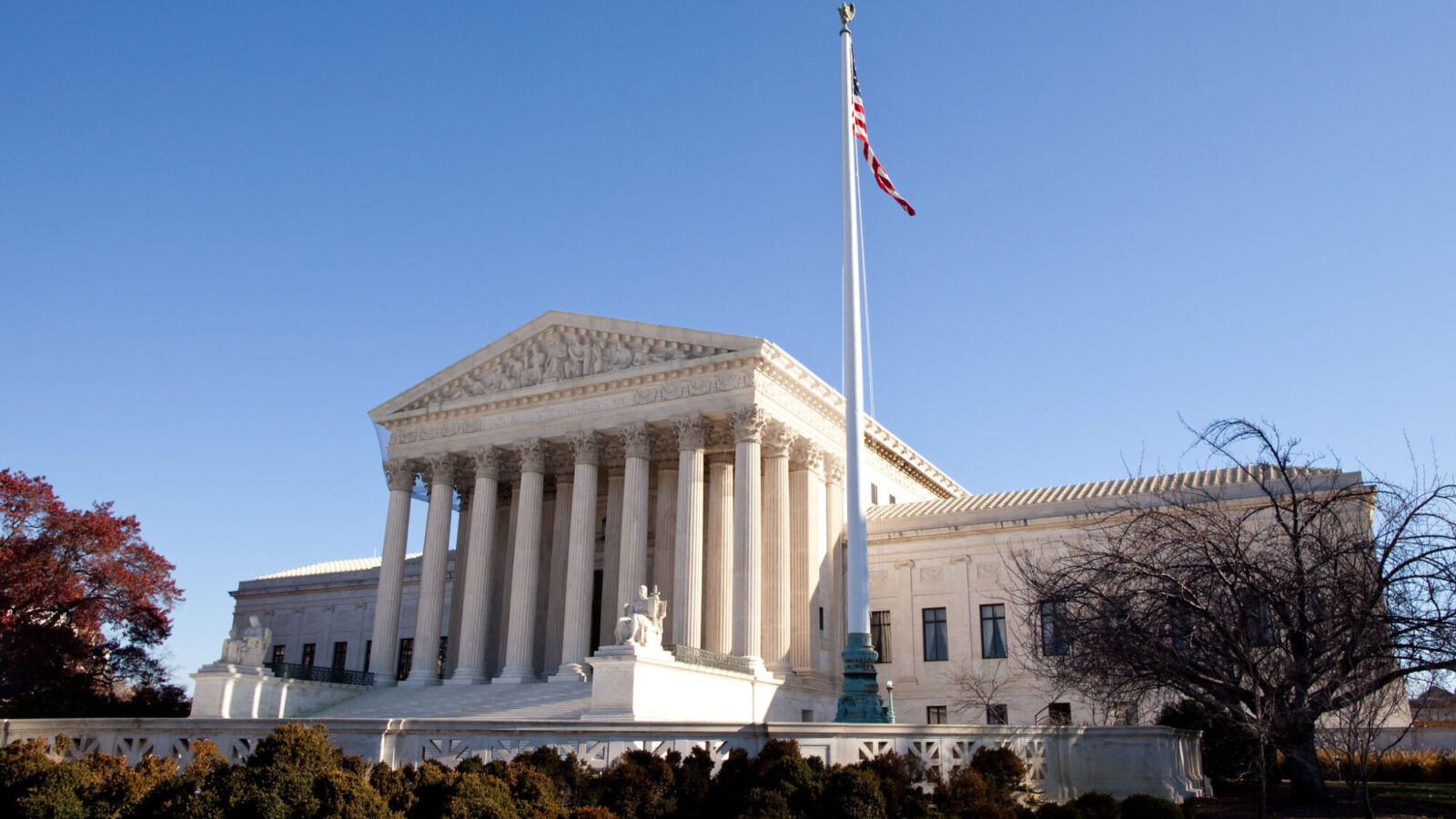
A narrow policy for mail-in ballots in a mix of a dozen-plus red, blue, and purple states was OK’d by the Supreme Court on Monday, with the practical effect of state legislatures avoiding an election-year panic to update their voting rules — but also of adding the latest bullet point to a list of claims about the legitimacy of elections with permissive mail voting.
The case Watson v. Republican National Committee ultimately asked a straightforward question: Does the definition of “election” include the receipt of votes? Because if it does, then, as the RNC argued, a Mississippi law that counts late-arriving mail-in ballots as long as they’re postmarked by Election Day must be illegal — since Election Day is defined in federal law as the first Tuesday in November.
A 5-4 majority of the court ruled that it didn’t. “The defining element of an ‘election’—the term used in all three federal statutes [invoked by the RNC]—has always been the electorate’s choice of candidate,” wrote Justice Amy Coney Barrett, an appointee of President Trump, in the majority’s opinion. “And a related federal statute, the Uniformed and Overseas Citizens Absentee Voting Act (UOCAVA), confirms that while federal law dictates when ballots must be cast, state law dictates when they must be received.”
Thus, Mississippi’s “postmark rule” — which the RNC challenged successfully in a federal appeals court — isn’t invalidated by federal statute. Thirteen states have similar rules, with varying grace periods for counting eligible late-arriving ballots; the ultimate fate of all of them might’ve been on the line in this case.
To preface the court’s decision, Barrett observed that “[t]he question before us is a narrow one about timing,” having nothing to do with “the general practice of absentee voting . . . [or] the use of the Postal Service or a common carrier to transmit ballots.” Accordingly, the number of votes relevant to this case was limited. An analysis from the elections website VoteBeat found that mail ballots received by officials after Election Day in November 2024 amounted to fractions of a percent to 2-3-percent in 13 states with a postmark rule and available data.
Political consequences
Nevertheless, the ruling has immediate political consequences, which are more relevant in the aggregate. Justice Samuel Alito, who wrote the court’s dissent, articulated them.
“Mail voting [] presents a greater opportunity for voter manipulation, a more vulnerable chain of ballot custody, and a diminished ability to detect improprieties in real time. Today’s decision compounds these vulnerabilities,” he argued. “Allowing absentee ballots to pour in over the days and weeks after election day, by which point preliminary election returns are being publicly reported, creates greater opportunity for fraud and risks further undermining the public’s confidence in election integrity.” (“As we have said time and again . . . policy arguments are properly directed to legislatures, not courts,” Barrett wrote in response.)
Soon after the court announced its decision, President Trump and likeminded critics exemplified Alito’s forewarning sensationally. “In light of the tremendous loss in the Supreme Court today concerning Voter’s Rights, and the fact that ‘people’s’ votes are allowed to be counted LONG AFTER an Election is over, it is more important than ever to pass THE SAVE AMERICA ACT,” Trump posted online. “There is no excuse for a politician, or otherwise, to be against [its] requirements. There is only one reason to oppose — CHEATING!”
“You’re watching the 2026 election being stolen in real time, while our Senate does absolutely nothing,” the Trump-aligned activist Scott Presler echoed.
As observed, however, postmark rules aren’t particular to blue states: They exist in Texas, West Virginia, and Alaska, in addition to Mississippi (whose secretary of state, Michael Watson, was named in the Watson case). Nevada and Virginia have them, too. The blue states with them, from east-to-west, are Massachusetts, New York, New Jersey, Maryland, Illinois, Oregon, Washington, and California.
“Today’s Supreme Court ruling is a significant moment for American federalism and for the constitutional framework that governs how elections are administered in this country,” stated Republican former governors Jan Brewer (Ariz.) and Pat McCrory (N.C.), along with three other state leads of the nonpartisan organization RightCount. (Declare is affiliated with RightCount.)
Benefits for election administration
The last of the postmark-rule states listed above has been the target of an extraordinary amount of delegitimizing messaging in recent weeks, after a Republican candidate in the Los Angeles mayor’s race slipped from second to third during the counting of mail ballots after California’s primary day. The result shut the party out of the two-candidate general election (not an unusual occurrence in the deeply blue state, with its primary format that requires all parties’ candidates to run against each other). Jesse Salinas, the outgoing president of California’s statewide election clerks association, told Declare that he’s received twice the amount of media inquiries this month than he has in even the most contentious of previous election years.
The Watson ruling, however, saves Salinas and his ilk what some of them called a “nightmare” possibility in the days leading up to the decision. Salinas said last week that he and some fellow clerks had begun conversations with California’s secretary of state, state legislative leadership, and Gov. Gavin Newsom’s office about how to ensure the state’s election system would comply with a ruling that favored the RNC. To illustrate the challenges, Salinas said he worried that one idea floated, of creating a “bifurcated” system for state and federal races — Watson was a test of a federal definition of elections — would start another strain of voter distrust.
“This [would] just create a lot of concerns unnecessarily because they will ask, ‘Well, why is it being treated differently, why are my ballots being treated differently?’ It just opens up a whole host of other concerns.”
Salinas’s counterpart in Oregon, Dag Robinson, told Declare that a bifurcation idea had also been mentioned as a contingency in discussions with his state’s secretary of state, along with the legislature working this summer to align Oregon election law with whatever the Supreme Court determined; and determining new vote-counting procedures to separate eligible late-arriving mail ballots from all other ballots, and ensuring the former didn’t count for federal races, even if they could for state ones.
“All of the options are complex, technical, and expensive,” Robinson said.
But, as of now, unnecessary.
Taking Elections Seriously, with Gabriel Sterling and Stephen Richer