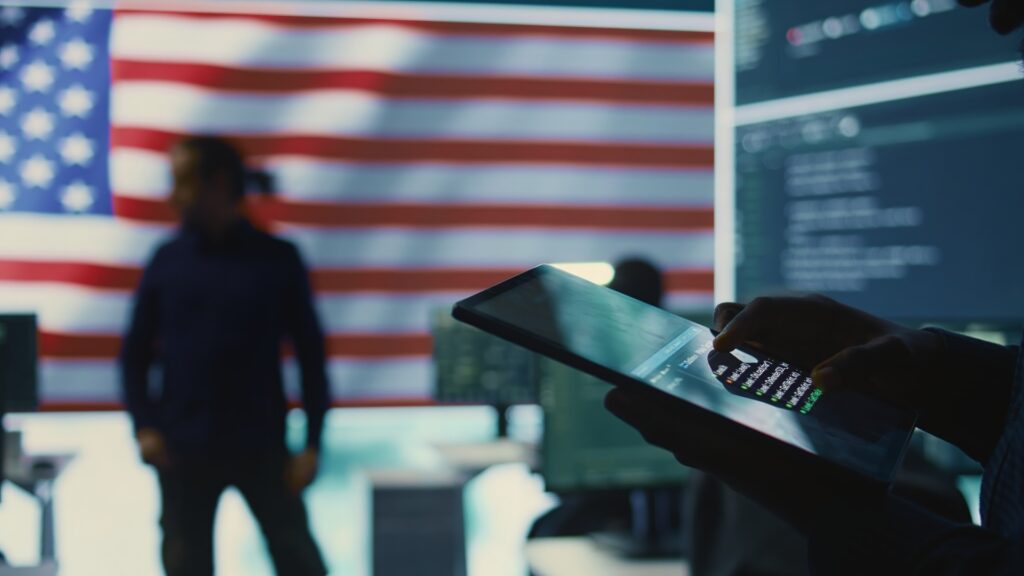
Artificial Intelligence is everywhere now: in our phones, in our computers, even in our cars, just to rattle off a few spaces. But it’s still a mystery as to what it holds for the future of society overall. One major event of that future: the upcoming 2026 elections.
From one perspective, the role of AI in elections is cause for alarm, from “deep fakes” of officials to scalable attacks on cybersecurity — novel problems that go above and beyond mis- and disinformation seeded by foreign actors in new media in recent years. There will be much analysis of such threats in the months to come. But consider an alternative, well, “prompt:”
As election officials strive to run efficient, secure, and accessible elections, AI offers tools that can make many of the traditionally labor-intensive, error-prone tasks more reliable, scalable, and responsive. Properly implemented, AI has the potential to reduce costs, speed up processes, improve voter services, and strengthen election integrity.
Did I write that? No, AI did. Is it accurate? Yes.
Meet the intern
So, how does the election profession position AI to benefit overburdened, overworked election officials? One way is to think of AI as a “really smart intern,” says Bill Gates, the Director of Arizona State University’s Mechanics of Democracy Lab.
“We’re continuing to make sure we’re keeping elections safe from AI, but also we’re taking a look at how AI could help elections officials to run elections more efficiently and potentially improve the voter experience,” he put it during a recent local forum.
When we think of interns, in general, we think of newbies to the industry in which they are working. The same can be said for AI. Meaning, it needs to be monitored, checked, and double checked for accuracy — just like you would an intern who is tasked with sending a document to clients, for example. But while quality control is essential, the point is that AI tools have the potential to be high achievers, too.
One example of AI being used in the 2024 election was in Broward County, Florida. A chat bot was used to answer phone calls about polling hours, ballot drop-off locations, and other easy-to-answer questions. Other officials have touted using AI to modernize poll worker training and develop clearer informational materials.
Gates cited small counties as the ones that could really use the help, at a time when the country is hyper-focused on election security and the personnel is at a premium in many of America’s county clerk offices.
TJ Pyche, who is a member of the ASU lab’s AI + Elections Clinic Advisory Council, drives the point home in an article for the project’s Substack. “If you work in elections today, your job has changed. Running an election office no longer looks like managing a mostly non-technical process that comes together a few times every couple of years. Now, it looks like leading a complex public organization under scrutiny, pressure and constant change,” he writes. “In other words: Election officials are now functioning as CEOs.”
Therefore, if election officers are going to act like CEOs now, they have to be abreast of what’s available and change with the times.
“AI represents a fundamental change in how work gets done, how staff spend their time and how public trust is maintained.”
Kind of like the old, ‘work smarter, not harder’ mindset.
“AI boot camp”
Given that the practical applications of this technology are still in their early days, how AI can actually help election officials is an ongoing question. At the frontier of implementation, Michael Moore, another panelist and chief information security officer for the Arizona Secretary of State’s Office, suggested that “boot camps” should be held around the country to educate election officials on the ups and downs of AI; how to use it as a tool, in addition to how to avoid mistrust in its use.
Gates’ group is on top of the idea. They’ve scheduled AI and election clinics around the country, focused on using AI for communications and information management purposes. (“I don’t know anyone suggesting that AI be involved in tabulation,” or vote counting, he said earlier this year.)
The first “AI and Elections Clinic Bootcamp” was held in Phoenix last month, structured as a day-long workshop to give local election officials hands-on exploration of AI tools. There was another one in Washington, D.C., on the calendar for early December.
Dr. Allison JoAnn Lester, who teaches about AI and democracy at ASU, said that the first boot camp sketched “a very specific kind of roadmap, where election officials stay firmly in the driver’s seat while AI becomes a carefully trained passenger.”
While the test drives ramp up now, the real-world test is less than a year away.