
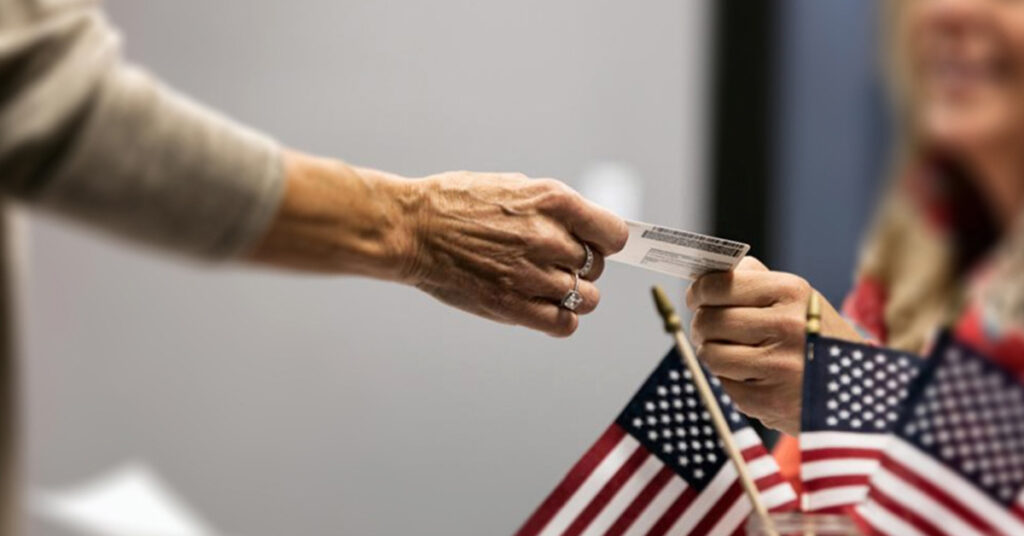
The ballot measure’s website is just a blank page now. “Voter ID for ME,” a useful branding pun for a Maine-based initiative, disappeared from the Internet as quickly as it did from voters’ consideration on Election Day earlier this month. They overwhelmingly turned it down, 64 to 36 percent. The result appeared to be a disconnect from the 30-plus states that have some form of voter ID requirement.
But the details and context, including from Wisconsin earlier in 2025, actually clarify the popularity of voter ID itself — and the unpopularity of more ambitious reforms to the voting process, like the ones bundled together with Question 1 in Maine. Despite being labeled a voter ID initiative, the proposed law was, in fact, tethered to other requirements, like limits on drop boxes and available days to request an absentee ballot. The language of the proposed statute was so long, and the provisions so numerous, that the wording at the end of the ballot question — “. . . and make other changes to our elections” — created disagreement between advocates and the State of Maine.
“Question 1 included many restrictions to voting beyond just a single question of should voters be required to provide one of a few permissible IDs when voting, including substantive changes to absentee voting,” Maine secretary of state Shenna Bellows, a Democrat, told Declare. “I am a strong advocate of absentee voting, which helps contribute to Maine’s consistently strong election turnout, and am pleased that voters upheld Maine’s free, safe, and secure elections.”
Setting aside whether “restrictions” is a fair description, Bellows’s characterization of the measure’s breadth is inarguable. It would’ve required voters to present an acceptable form of identification for in-person voting or an ID number for voting absentee, yes. But the second part of her quote reflects what ultimately sank Question 1: a mess of changes to absentee voting itself. The eventual language that Bellows put on the ballot was as follows:
Do you want to change Maine election laws to eliminate two days of absentee voting, prohibit requests for absentee ballots by phone or family members, end ongoing absentee voter status for seniors and people with disabilities, ban prepaid postage on absentee ballot return envelopes, limit the number of drop boxes, require voters to show certain photo ID before voting, and make other changes to our elections?
Alex Titcomb, who led Voter ID for ME, took Bellows to court over that framing, on the grounds that it was misleading and lacked clarity and concision, basic statutory requirements in the state. In the end, Maine’s highest court rejected the arguments, writing, in part, that “a ballot question is fatally misleading only if a voter would be led to vote contrary to the voter’s intent.” In other words, whether the particular ordering of the items inside the ballot question favored one side of the issue or not, that’s not a relevant issue to argue in court.
Politically speaking, the fact that voter ID was buried underneath several unrelated ideas helped bury the measure. The state is one of the most rural in the country, and absentee voting holds a special place in many Mainers’ election plans. Toying with it is risky.
“A narrow voter ID requirement would have passed 60-40, because it’s a popular and commonsense policy,” Steve Robinson, editor of the right-of-center nonprofit publication Maine Wire, said in a statement to Declare.
Contrasts in Wisconsin and elsewhere
Robinson’s analysis tracks with the experience of other states across the country, including one earlier this year in the upper Midwest. In April, Wisconsin voters weighed in on a straightforward constitutional proposal like the one he described; it was literally just two paragraphs long. Its result was almost the inverse of Question 1 in Maine, being approved by voters 63 to 37 percent.
“For clarification, photo ID is already required by Wisconsin State Statute. But a ‘yes’ vote would amend the Wisconsin Constitution to include this requirement, which will further protect the integrity of the voting system from our leftist-activist WI Supreme Court,” wrote Wisconsin Republican state representative Rob Kreibich in January this year.
Compare that to Democratic arguments against the Maine measure, which honed in far less on voter ID than on the absentee ballot changes. “This initiative would dismantle that absentee voting system that so many Mainers rely on,” U.S. Rep. Jared Golden, one of Maine’s two House members, said, for example. “It would make it harder to vote for rural voters who live far from the polling place, voters with disabilities, seniors and people who work multiple jobs or can’t get away from the workplace on Election Day.”
North Carolina and Nevada will consider straightforward voter ID questions similar to Wisconsin’s next year. In Nevada, constitutional amendment proposals that appear on the ballot need to be approved in consecutive elections; in 2024, Nevadans approved the first round of theirs with a resounding 73 percent.
Right now, 23 states ask for a photo ID, and 13 states also accept non-photo IDs.
Opponents of Question 1 in Maine outraised its advocates by a significant margin: As of the last filing deadline before Election Day, the tally stood at $1.7 million against, and about $600,000 for. “By adding absentee ballot changes, the Voter ID advocates allowed the out-of-state billionaires to fund dishonest ad campaigns focused on absentee voting,” Robinson added. His criticism echoed that of Titcomb and other Question 1 supporters, who argued that the effects of the non-voter ID changes were overstated by opponents.
The ultimate issue may have been that such changes were included at all.