

It’s been nearly a decade since one of the defining phrases of the century entered the English repertoire. It was about the planned Fyre Festival, that bogus musical island getaway that sold 5,000 tickets and wound up entertaining a thousand times that many people with tales and a documentary about its debacle. Somewhere along the cursed timeline, a marketing staffer apparently untroubled by mounting signs that the event would go off with many debilitating hitches reportedly said: “Let’s just do it and be legends, man.”
Which brings us to President Trump’s solo efforts to reform the election system. They’ve run into legal trouble once, twice, and three times just this week. First, the federal district court for Washington, D.C., determined that the Department of Homeland Security’s expanded use of a data tool for verifying certain immigrants’ eligibility for federal benefits went beyond the federal statutes that created it and have updated it. That tool is called the Systematic Verification for Entitlements (SAVE) Program; the president wanted to make it a program for the systematic verification of voter citizenship. That was Monday.
Second, the District Court for the District of Massachusetts ruled that the president’s directive to the Election Assistance Commission and the Department of Defense to require proof of citizenship on voter registration forms for everyday citizens and members of the military exceeded the language of federal election law (in particular the National Voter Registration Act and the Uniformed and Overseas Citizens Absentee Voting Act). That was Wednesday.
Finally, Thursday, that same, busy federal court voided the president’s order to the Department of Homeland Security to create 50 state lists of verified American adults (“State Citizenship Lists”); and to the Postal Service to make “proposed provisions” for states mailing absentee ballots only to individuals named on state-prepared eligibility lists provided to the federal agency. The judge excerpted a line from the majority opinion in a landmark Supreme Court case, the Youngstown Steel case, which sums up all three of these challenges to President Trump: “In the framework of our Constitution, the President’s power to see that the laws are faithfully executed refutes the idea that he is to be a lawmaker.”
That’s a blinking red light, hung many years ago. And yet the nation’s chief executive just sped right through it. Just did it, man. A legend’s status for having done it, though, seems in doubt.
What gives?
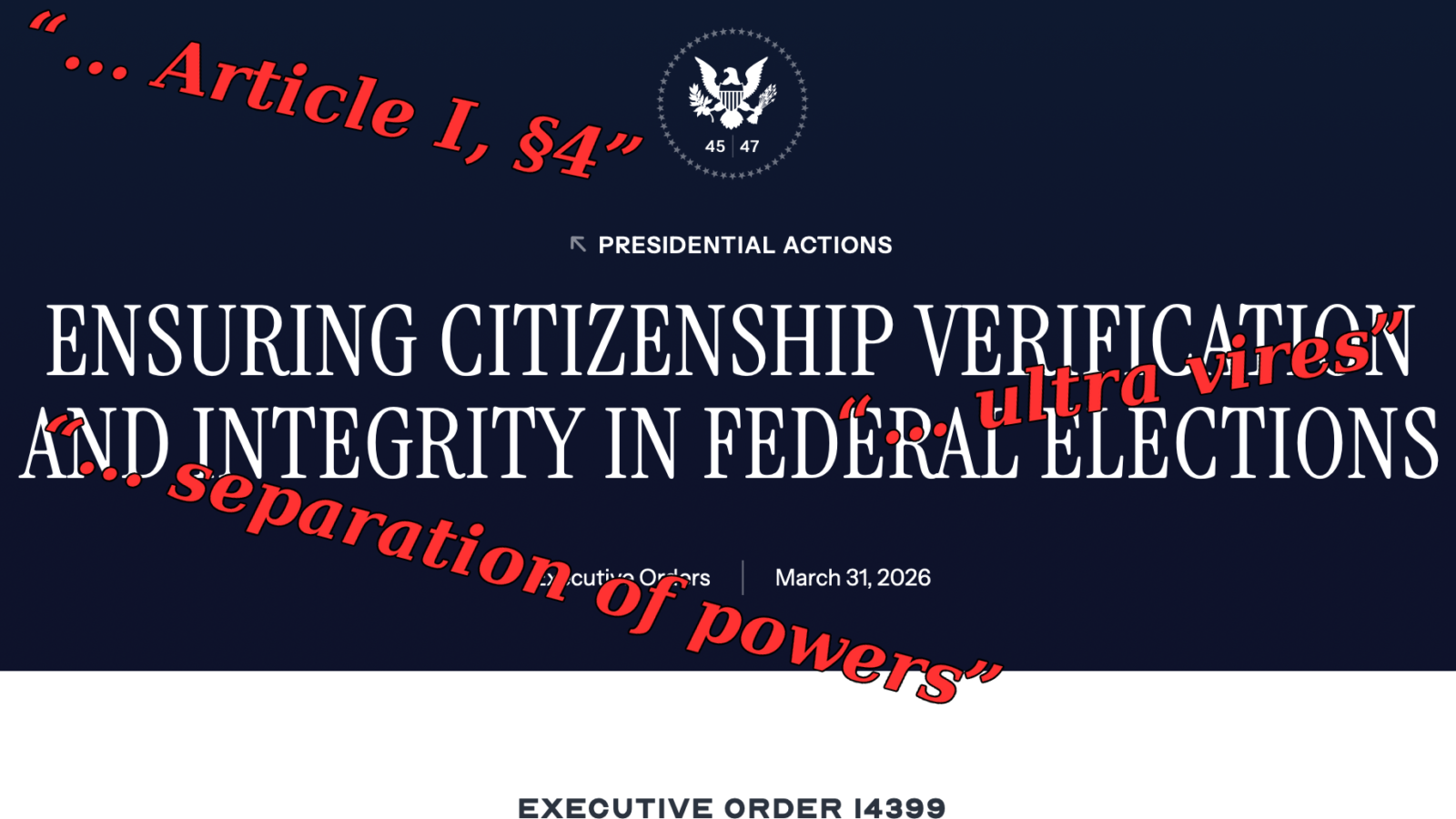
Cultural references aside, the judiciary’s disapproval of President Trump’s two major executive orders on elections, from which these three cases stem — March 2025’s Preserving and Protecting the Integrity of American Elections, and the March 2026 order Ensuring Citizenship Verification and Integrity in Federal Elections — are much more about bright-line tests of precedent and legality than the political backgrounds of the ruling judges (each was appointed by a Democratic president).
Missouri has more electoral votes than the U.S. has had executive orders about elections through its history. In addition to the two mentioned in the previous paragraph, Trump issued a significant one during his first term, titled Establishment of Presidential Advisory Commission on Election Integrity. (The commission was created to receive and review claims of voter fraud from the 2016 election, sued from every which way, disbanded after half a year, and “did not create any preliminary findings.”) In-between the two Trump administrations, President Biden released an order called Promoting Access to Voting, in part directing federal agencies to “consider ways to expand citizens’ opportunities to register to vote and to obtain information about, and participate in, the electoral process.”
Prior to all this, President Obama created a commission to “identify best practices and otherwise make recommendations to promote the efficient administration of elections;” President Clinton issued an executive order to do that most presidential of things, to “take care that the laws be faithfully executed,” in directing federal agencies to implement the National Voter Registration Act; and President Kennedy established a commission to study and make recommendations for increasing voter participation. And that’s basically that.
The law is why
The rarity of a thing alone doesn’t mean that it’s legally dubious. But it does raise the question. In this instance, there are clear answers.
The Constitution provides state legislatures with first dibs to set the “Manner of holding Elections for Senators and Representatives,” and Congress with the power to weigh in if it so chooses; it gives the chief executive, as is the case with any lawmaking authority, no such power. The Massachusetts court reasoned that no federal election law created to date directs the executive branch or otherwise gives it authority to, for example, add a requirement for documented proof of citizenship to federal voting registration forms, any more than one for a birth certificate to demonstrate 18 years of age. Congress could try to change these standards, like with the SAVE America Act; that legislation’s existence again “refutes the idea that [the president] is to be a lawmaker,” to reinforce the line from the Youngstown Steel opinion.
If the political associations of the D.C. and Massachusetts judges are still too sticky to shake, consider this from the legal and political scholar Adam Feldman: Of 232 legal decisions that went at least partway against a Trump executive order between January and mid-August last year, “Democratic appointees ruled against the EO [or related agency action] about 88% of the time; Republican appointees did so about 77% of the time.”
“The gap tracks expectations—but the striking fact is how often judges from both camps found legal defects serious enough to sink the orders,” Feldman wrote.
Let’s do it and meet dead ends, is more like it.
(Watch more: “What Happens if a ‘President Newsom … Governs by Pen?'” with Declare contributor Trey Grayson)

State of the Secretaries with Michael Adams