

During the past year, I’ve had individual conversations with many acquaintances, friends, and family members prompted by this (paraphrased) question: I wonder if the best outcome is they just . . . keep going?
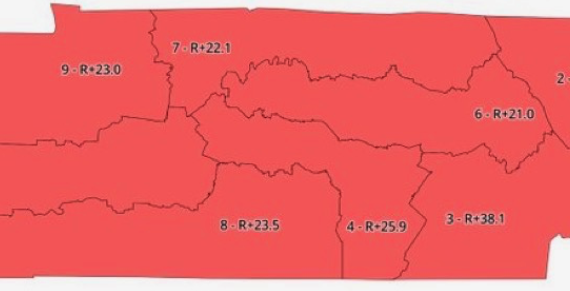
Just . . . keep gerrymandering. Do it so much that red states “crack” majority-black and Democratic districts to make their states’ congressional maps look like Trivial Pursuit wheels — except in the shape of, say, trapezoidal Tennessee. So much that blue states have 100-percent Democratic districts, shaped like rock formations, if that’s what it takes.
So much that House members start representing geography shaped like Mobius strips.
So much that Captain Ahab develops FOMO. What fun is hunting a dumb whale when the banger, “For hate’s sake, I spit my last breath at thee,” could be used before creating a new jurisdiction from the outline of spittle on a blank piece of paper?
Just, in other words . . . let them wear each other out. And see if sanity returns once they regain their energy.
If using unnamed “friends and family” as writing inspiration isn’t one cliche too many, I’ll add another here and say: You get the point. Only I mean it — because it’s one that many Americans evidently agree with.
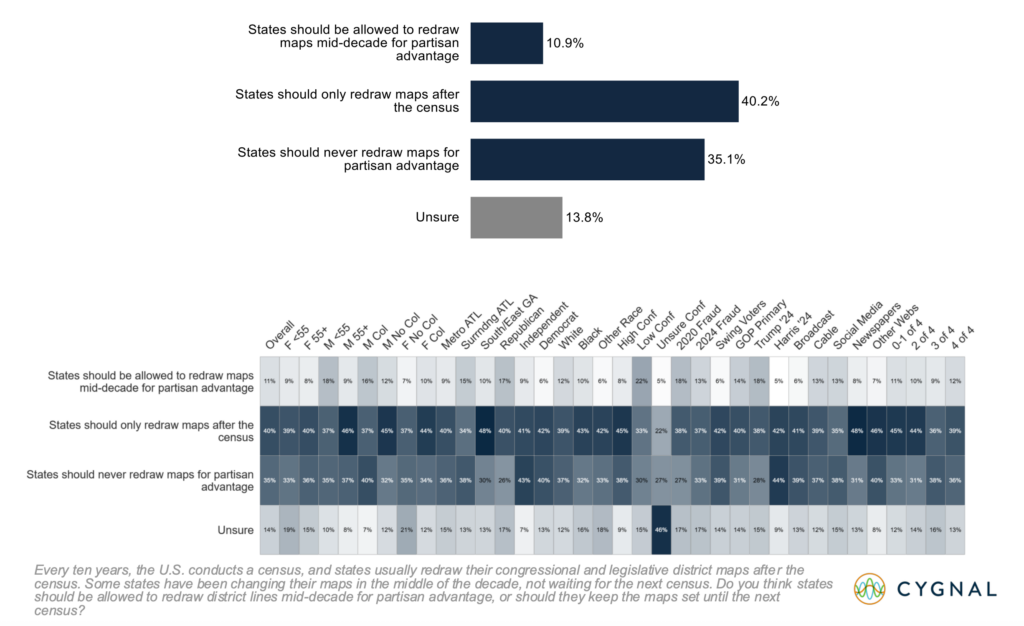
As the unusual process of “mid-decade redistricting” piles up in the news, voters appear to be cold to the concept of it. Letting politicians “wear each other out” in the fight, so to speak, would be just desserts. In Georgia, for example, Declare partnered with one of America’s top polling firms, Cygnal, to ask: “Do you think states should be allowed to redraw district lines mid-decade for partisan advantage, or should they keep the maps set until the next census?” The question was framed as a reflection of reality; maps aren’t being redrawn during an unusual year to make Americans feel like fresh-baked chocolate chip cookies. They’re being redrawn for power. The answer to it? Seventy-five percent total were opposed.
Granted, this was asked prior to the decision last week in Louisiana v. Callais, which ruled that the drawing of a second majority-black congressional district in the state was an unconstitutional racial gerrymander — sparking a wildfire of discussion and, in some cases, action in Southern states to redraw their own maps as soon as possible. South Carolina was an example of the former, and Alabama of the latter. Georgia governor Brian Kemp said last week that he wouldn’t convene state lawmakers to redraw ahead of this month’s primary elections, but could later this year in preparation for 2028.
There are other “proxy variables,” so to speak, which could reflect the electorate’s attitude toward mid-decade redistricting. Declare and its polling partners have asked voters in several states about the possibility of “court decisions changing election rules close to the election” this year. In Nevada, 80 percent of likely voters said they were at least “somewhat” concerned (46 percent said “very). Seventy-five percent said so in Wisconsin, and 79 percent did in Arizona.
Anecdotally, many Indiana Republicans went to the mat late last year to block mid-decade redistricting as a defense of their state’s rights against short-term political wishes from the national party. As of this writing, voters in the Hoosier state were selecting nominees in the primary, some of whom on the GOP side were backed by President Trump and his allies against sitting state legislators because of the redistricting issue. As of the days leading up to this writing, however, those Republican incumbents were holding their ground. As Politico reported:
It’s been telling that few, if any, of the Trump-backed challengers have made redistricting itself a focal point of their messaging. And some Republicans are viewing Tuesday’s election as a test of something larger than just Trump: federalism.
“That’s Washington D.C. influence trying to tell Indiana what to do, or maybe even retribution for what it didn’t do,” Rodric Bray, Indiana’s Senate President Pro Tempore who led the charge against Trump’s redistricting push, told POLITICO in a rare interview. “Federalism is important to me. It’s how our system is set up, how our Constitution has been set up, and states have and should have control to govern themselves for almost every issue.”
Here’s another question, then: Given the polling, and the given the mixed reception among state-level people to gerrymandering in between censuses, who is mid-decade redistricting actually for? For the People, or for a political class that the People try to send home election cycle after election cycle — an impulse that becomes more difficult to realize the safer most congressional seats become for one party or the other?

Stephen Richer’s Testimony to House Judiciary Subcommittee on Noncitizen Voting