

Poll analysis · Declare / The Tarrance Group · Wisconsin
78% of Wisconsinites Back ‘Pre-Processing’ of Mail Ballots
The change would speed up the counting of results on Election Day but has struggled to find traction amid failed reform efforts in the legislature.
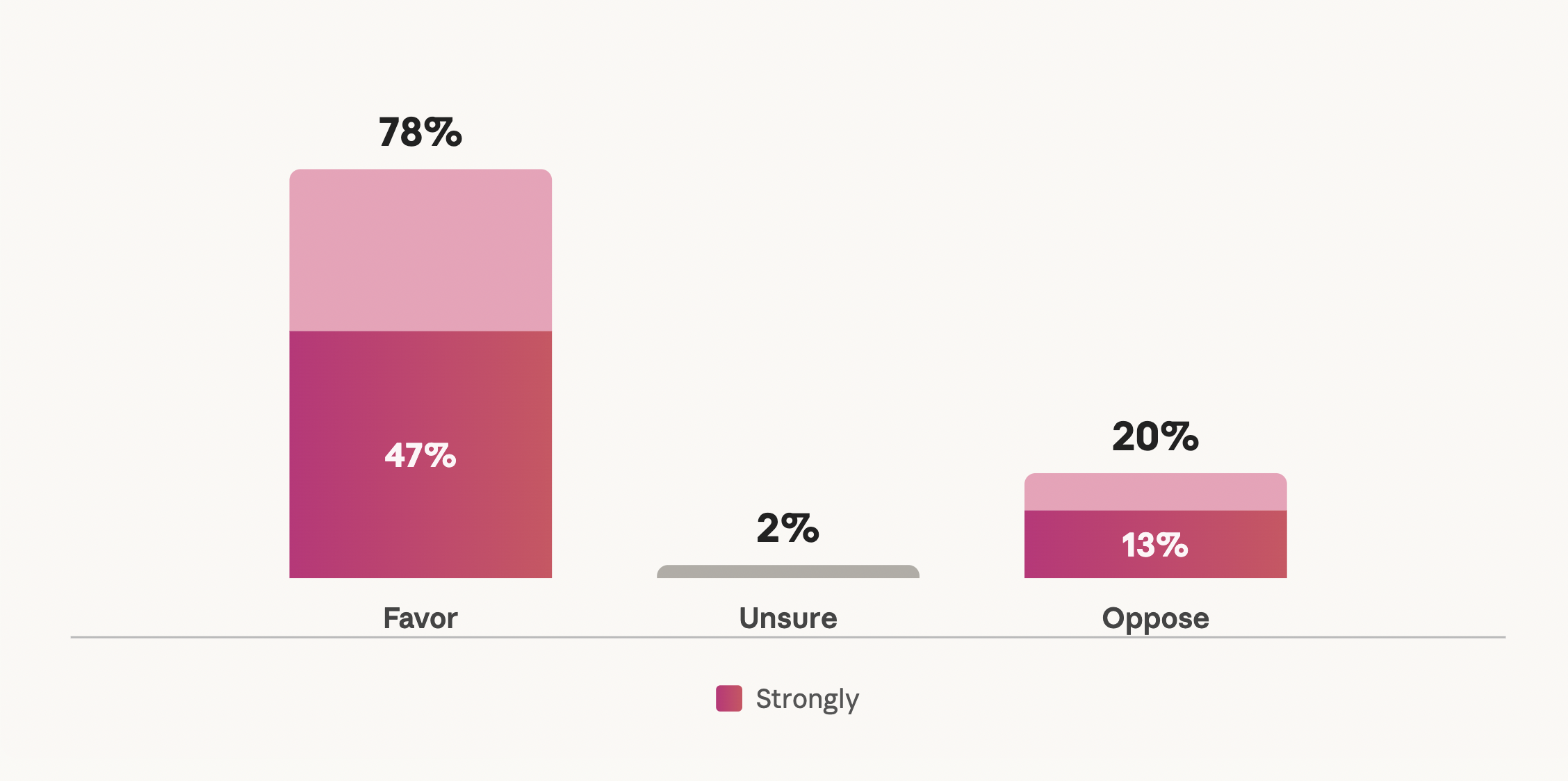
“If you don’t succeed at first, try, try again” isn’t always the most practical advice to follow. But when four out of every five people want to see what has failed — again and again — still come to fruition, the old saying might actually have spry legs.
A Declare/Tarrance Group survey of Wisconsin likely voters has found that 78 percent of them support the policy of “pre-processing” absentee/mail ballots prior to Election Day, such that they’re “checked in” and ready to be counted on Election Day. It’s an idea that garners support across the aisle for speeding up the reporting of votes and is a common practice in states across the country. In 43 of them plus D.C., it’s allowed; in Wisconsin and just six others, it’s not.
That status quo has held for multiple legislative sessions despite repeated efforts to change it, led on the Republican side by former election committee chair Scott Krug in the state assembly. (Krug is a member of RightCount Wisconsin’s Leadership Advisory Council.) Most recently, the provision was pulled from a broader slate of election reforms last fall because of opposition within his party’s caucus. The Declare/Tarrance Group poll still showed that 67 percent of Republican likely voters favored it.
“On the ‘Monday process,’” the shorthand for the idea, “it’s 4th and short, there’s 10 minutes left in the game. Right now, I’m going to punt,” Krug said during a committee hearing in November. State Democrats have proposed it as a standalone since. But the drive to get the proposal into law has stalled.
Room for other ideas?
Ballot drop boxes are another aspect of Wisconsin elections that have toggled between disallowed and allowed in recent years. In almost every state where they’re legal, it’s according to a state law — some of which have security measures attached. In Wisconsin, however, they’re legal pursuant to a court order, providing an opening for the state legislature to pursue their own security standards.
The Declare/Tarrance Group poll found that at least 73 percent of each partisan subgroup (Republicans, Democrats, and Independents) would support “the creation of a statewide
standard set of rules regarding the issue of drop boxes, including access and security” that would be uniform statewide.
Widening the scope of the survey to more national matters, 54 percent of Republicans polled said that noncitizen voting worried them the most among a set of concerns relevant to the 2026 elections, which included the deployment of the military or ICE agents to the polls, federal pressure on Wisconsin election officials, cyberattacks, and court decisions changing rules in the middle of the election year. Whereas noncitizen voting was Republicans’ top concern, ICE agents at voting sites ranked highest among Democratic respondents (44 percent) and Independent respondents (24 percent).
With respect to the first issue, Wisconsin voters approved a citizenship voting amendment to the state constitution in 2024 with more than 70 percent in support. The amendment adds a layer atop a federal law from 1996, which bans noncitizen voting under penalty of fines, jail time, and deportation. Although noncitizen voting has been found in negligible amounts among states that have undertaken audits specific to it, the Wisconsin Institute for Law and Liberty has proposed a process for how Wisconsin can track and enforce its state’s amendment.
With respect to the issue of ICE agents at the polls, a Department of Homeland Security official reportedly told a call of state election officials last month that any suggestion of the possibility “is simply disinformation,” which was echoed by Kentucky’s secretary of state, Republican Michael Adams.
The Declare/Tarrance Group poll sampled 601 likely registered voters in Wisconsin between February 14 and 17.
 Cygnal · PennsylvaniaTo Pennsylvanians, Nation’s Elections Face Bipartisan Credibility Problem
 Opinion DiagnosticNC Republicans Favor State to Federal Election Control 63-18
 Deeproot AnalyticsState Control of Elections Favored in Giant National Survey
 The Tarrance Group · NevadaNevada Voters 50/50 on Supreme Court Issue Argued This Week
 Cygnal · ArizonaKnowing the Process Builds Trust in Arizona, Declare/Cygnal Poll Finds
 Cygnal · GeorgiaOnly 23 Percent of Republicans Support Full DOJ Voter Roll Request, Georgia Poll Finds