

If you are a Republican skeptic of the legitimacy of American elections, you likely believe that Congress’s failure to pass the SAVE America Act and the federal judiciary’s consistent rulings against the Trump administration’s involvement in local and state election work are laying the groundwork for unfair, if not unacceptable results on Election Day. A few days ago, I wrote why Republican candidates and political operatives themselves foresee other explanations for their expected defeats in the House and some potentially decisive races. And throughout this entire year, Declare has tried to put the policies and evidence of election integrity nationwide into perspective, with tools such as our Election Integrity Map.
Less discussed is the Democratic point of view. A combination of historical trends (the party opposite that of the president’s almost always netting congressional seats in Midterm years); a more unpopular president than usual, with even more unpopular policies; polls, professional election analyses, and “vibes” have given Democrats many reasons to think they could be headed for an especially successful night, in which they retake the House easily and also flip the Senate with perhaps a race or more to spare.
However, they are concerned this political state of play has been and will be defied by illegal behavior from the Trump administration. Even if courts have stopped the president’s executive orders on elections and certain election-related demands of local and state governments, many election officials have cautioned voters about using the Postal Service for mail ballots, for example. Additionally, Democratic leaders have voiced concerns about and prepared for the possibility that President Trump will direct law enforcement to interfere somehow, somewhere in the voting process on and after Election Day. Separate anxiety about congressional Republicans’ willingness to seat newly elected Democrats prompted a retiring House Republican (Don Bacon) and a House Democrat (Josh Gottheimer) to seek guarantees from a critical mass of their colleagues not to aid such a scheme.
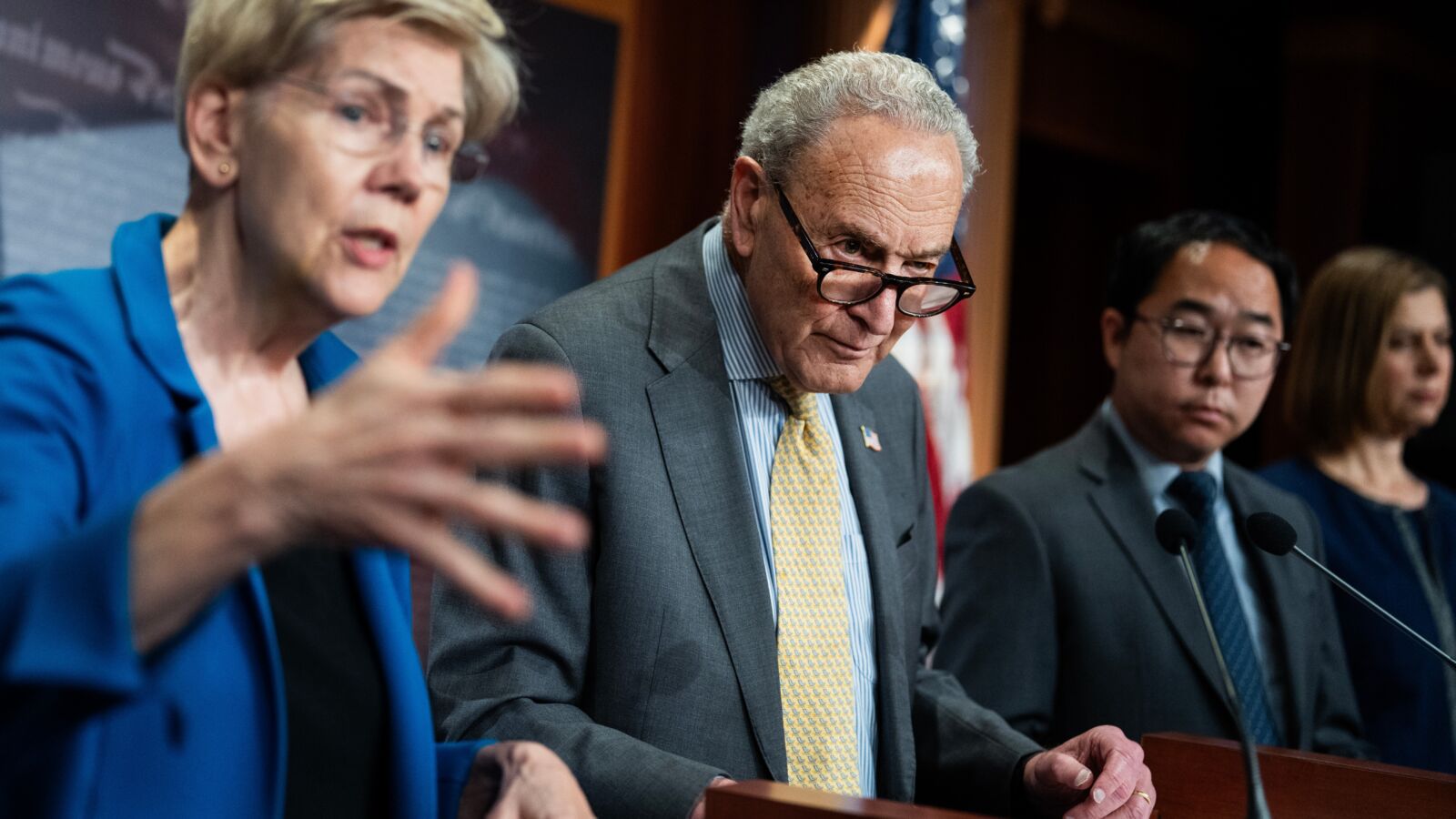
“It’s 50-50. We’re right on the edge of winning,” the Senate minority leader, Chuck Schumer, said of his party’s chances of retaking control of the Senate a month ago. “Two things could have us lose. One, they steal the election.” (The other was that big Republican ad spending would help their candidates surge.)
Regardless of the Trump administration’s behavior, the top-ranking Democrat in Washington putting “stolen election” language into the world was not a welcome contribution to the political discourse, as Declare contributor Gabriel Sterling wrote. For one, the very manifestation of it opens the door to not accepting the results — especially when the winds, as described a few paragraphs above, seem so strongly at Democrats’ backs.
However, there are two other things which could have Democrats “lose,” relative to lofty expectations, having to do with electoral variables and not cheating. Telling these two categories apart will be obvious — but acknowledging even the existence of the first hasn’t been.
Thing #1: Even with momentum, this year’s Senate map is not favorable to Democrats. Republicans have a 53-47 Senate majority, meaning that Democrats need to win four Republican-held seats and lose none of their own, or win five and lose one. (If they were to flip six, it would be indicative of a Democratic “wave.”) Republicans wrote off the North Carolina Senate race to replace the retiring Thom Tillis weeks ago, so that is one all-but-certain change. But according to the Cook Political Report, one of a few “gold standard” sources for election analysis, their odds are in the realm of 50-50 from there. Democrats have a realistic shot of also winning these “toss-up” or “leaning-Republican” races: Alaska, Iowa, Kansas, Maine, Michigan, Nebraska, Ohio, South Carolina, and Texas. Seven of these are solidly Republican states, which President Trump won by at least 11 percentage points in 2024. The other two feature a politically potent Republican incumbent (Maine) and a seat currently held by Democrats (Michigan), which, if they were to lose it, would require them to win in four, not just three, of the eight other toss-up or leaning-Republican states (which, again, are all red states in presidential years).
Not impossible. Yet the chances that Republicans hold the Senate (losing three or fewer seats on net), lose it narrowly (four-five), or lose it big (six or more) are all realistic — just as a matter of political dynamics.
Thing #2: Even if major pollsters are really good at what they do, they admit they are not perfect — and this is a weird year to poll.
Two interrelated factors that pollsters mention when they explain the uncertainty of their work are “nonresponse bias” and “weighting:” certain groups not responding to a survey in disproportionate numbers, and the calculation to weigh the responses from those groups more heavily so as to make sure they are “modeling” the electorate as accurately as possible. A Tufts University poly-sci professor and polling expert, Brian Schaffner, writes in the Boston Globe:
Pollsters did not weight their data nearly enough before 2016. That has changed. In 2024, a student and I wanted to get a sense of how pollsters were weighting their polls. We collected the data for all national and swing-state polls fielded during the final few weeks of the campaign. We compared that data to a similar set another student and I had collected in 2016. The shifts were striking. In 2016, only about one out of every four state polls was weighted for education. By 2024, three out of every four were.
The other major pattern we observed is an increase in the number of pollsters who weight their data for either party affiliation or whom people voted for in the past election. Nate Silver sees this practice as akin to cheating. He suggests that in polarized times, weighting by party allows pollsters to play it safe to avoid having their polls be too far off the mark. Some in the polling industry agree. But others, like me, argue that we should do as much as we can to ensure that our samples aren’t underrepresenting Republicans or Trump voters. We know how many people voted for Trump in 2024. Why not use that information to ensure that we have the same proportion in our sample?
On top of this, as the New York Times’s Nate Cohn writes, Senate control will come down to “self-identified Republican-leaning voters who voted for Mr. Trump but now disapprove of his performance and, at least as of our last poll, prefer a Democratic Senate candidate.” That is because of what was described in “Thing #1,” the number of key races taking place in unmistakably red states. The group Cohn identifies is not the easiest to predict; enough voters within it might “come home” on Election Day and help Republicans do well relative to expectations.
Here is the bottom line: The Trump administration has already been acting aggressively — and in the opinions of the federal bench, including both Democrat- and Republican-appointed judges, unlawfully — toward localities and states. At the same time, Democrats riding a wave of victories this November is no certainty, for purely political reasons. Accounting for that possibility, even if it does not come to pass, would keep the body politic from giving further into its disease.
Respect the Rules, Reject the Chaos: Why the Purcell Principle Must Hold