

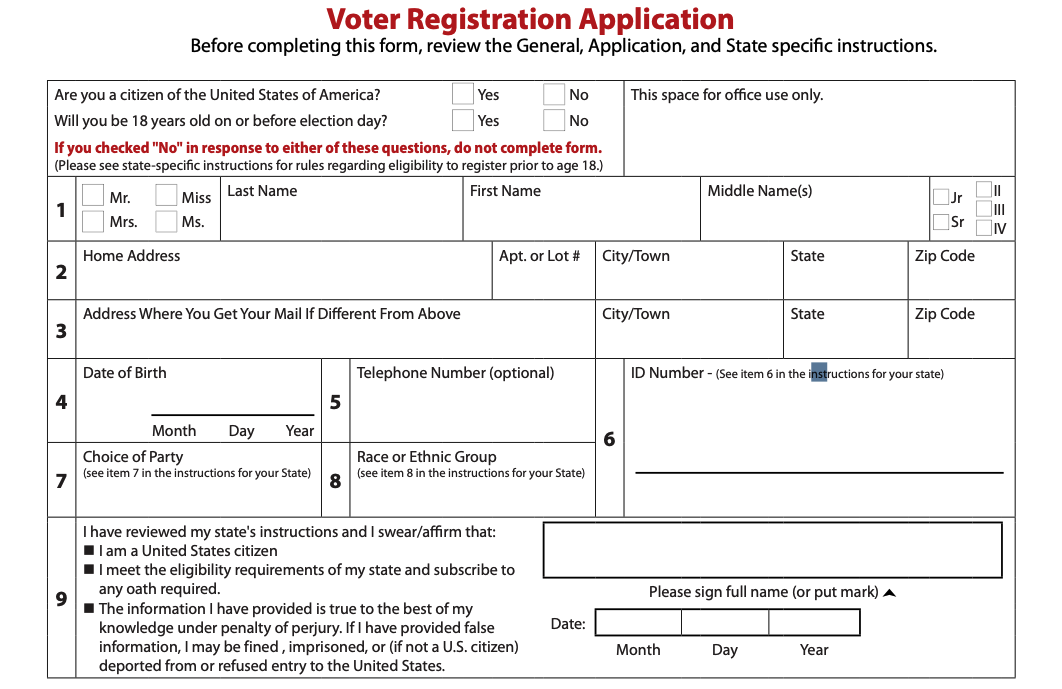
News reports indicating that federal agencies are veering into unfamiliar lanes to probe the incidence of noncitizen voting nationwide might indicate that little has been done previously to measure the scale of the issue. Not so.
And while the record is far from complete, it provides enough evidence to say how little it points to a problem of election administration — and how much it exposes a product of political manufacturing.
Training materials reviewed by reporters from The New York Times show that agents inside the Department of Homeland Security are being instructed to use a combination of public voter resources and government tools as part of a ramp-up, internally called the “Unlawful Voter Initiative.” The public resources include states’ purchasable voter files, which include names and a limited amount of associated identifying data, and even voter registration websites. Agents were told it’s fair game to input the voter data into such websites to check registration status, the Times reported on Wednesday.
A similar recent report from the nonprofit investigative outlet ProPublica explained in detail how DHS has made new use of far more sophisticated tools, used by the country’s top scientific researchers for national security purposes.
The extensive details in each published piece, including how some agents are being reassigned to handle these tasks — paired with the Trump administration’s public campaign during the summer to disclose its findings to-date and advocate for responses to them — send an unambiguous message about the extent of federal efforts. They amount to, as the Times characterized it, “an intensive, weekslong hunt:” a fair description from the perspective of either a supporter or a critic.
However, previous research provides sufficient information to describe an all-but-certain reality already. It includes the administration’s own recent findings; findings disclosed periodically by the states; and separate research undertaken by nonprofits, both on the political right and left. All the data should be read in the context of the actual legal proceedings that have resulted, as well as the context of existing law and election administration practices.
First, DHS announced in July that it had found “more than 250,000” noncitizens registered to vote in “four states for which public data files have been reviewed:” California, Pennsylvania, New Jersey, and Nevada. By contrast, in the same fact sheet, it said “a total of 25 different states [had] processed more than 68 million registration records through the SAVE system” as of late June. Of those, 28,000 were flagged as noncitizens.*
“There is an undeniable pattern emerging as DHS begins to unravel the horrific damage done by the open border policies of the Biden administration,” the conclusion of the sheet reads. “States that have adopted alien-first policies instead of American-first policies have a disproportionate number of non-citizens on their voter rolls.”
First, note the difference in source material. Only public data was used in an attempt to find registered noncitizens in the four-state set that includes California. Public data, which are just the data included on voter lists available to certain members of the public for a fee (the restrictions vary by state), include a limited number of fields of “personally identifiable information.” Yet private or sensitive PII is necessary to identify individuals and the relevant government records associated with them with certainty. For the purposes of records identification, “Joe Smith” is just a guy named Joe Smith until he has a Social Security Number, for example.
Second, the aforementioned SAVE system by itself, in the absence of other tools, can be insufficient for determining noncitizen voters even with PII, such as partial Social Security numbers. SAVE, or the Systematic Alien Verification for Entitlements program, was created originally to help agencies determine federal benefits eligibility for immigrants. The second Trump administration has worked to expand its use for checking voter rolls, in voluntary partnership with states. As a letter from 73 county election officials in Missouri sent to their secretary of state last December put it, however, “We are aware that states such as Arizona and Georgia have utilized SAVE as a tool for voter verification for years, and the effectiveness of such efforts depends on clear, consistent, and transparent procedures.” Missouri is one of the “25 states” mentioned by DHS in its July announcement.
The way the secretary of state’s office used the tool, the officials said — running the state’s full voter roll through the SAVE system, then directly notifying counties of who was flagged — led to “deeply flawed” results. “[T]hey are outdated, inaccurate, and include individuals we know to be U.S. citizens—our neighbors, colleagues, and even voters we have personally registered at naturalization ceremonies.” As a starting point for a “more effective and lawful solution,” they suggested a bill sponsored by a Republican state legislator that, in part, would require Missouri’s department of revenue to share the citizenship information it collects with the secretary of state — putting into relief the Trump administration’s difficulties with data quality and methodology.
This extends to a recent noncitizen voting report posted to the U.S. Census website, whose process was even more questionable, as described for Declare by Georgia election official Gabriel Sterling.
For readers who are interested in additional background, Declare contributor Stephen Richer has written about the potential usefulness of SAVE as part of a toolkit. And Declare contributor Trey Grayson broke down how Georgia monitors citizenship on the front end of election administration, which the Missouri officials invoked as a positive example, earlier this year.
Second, Richer has been tracking state-led audits of noncitizen voting for our regularly updated Election Integrity Map. As the Missouri officials implied, audits undertaken by states often include data and processes likely to significantly reduce the number of false positives relative to federal findings, which stem from lower-quality data and fewer necessary steps. Most states that have conducted such audits are indeed red states, but the overall numbers still appear to be much smaller than what DHS concluded from its 25-state, SAVE-only research (the list of audit states and 25 states don’t overlap directly). The conclusions of a Georgia audit released this week are a recent example.
A handful of purple-to-blue states, or at least those with a Democratic secretary of state, have released either their own audit findings in recent years or disclosed administrative errors that resulted in noncitizen registrations. New Jersey’s was the most notable blunder: In July, the governor announced that a “serious software error” in the state’s DMV registered 6,600 people between 2023 and 2024 who indicated they were not U.S. citizens. In May, Oregon’s secretary of state announced that “clerical, technical, and policy errors” led to more than 1,900 individuals being registered to vote who did not provide proof of their eligibility. Local- and state-level officials in Arizona, Michigan, and Pennsylvania have also undertaken their own audits and found only a handful here and there (as in, measured in the dozens combined) of noncitizen registration and cast-ballot instances.
Finally, nonprofit and journalistic investigations have provided additional evidence to weigh. The Heritage Foundation’s election fraud database, which includes data between 1982 and 2025, includes 100 records under the subcategory marked “alien.” According to an August report from ProPublica, “Through May, [federal] prosecutors had charged fewer than four dozen people with crimes related to noncitizen voting . . . getting convictions or guilty pleas in 14 cases.” These legal proceedings are from a sample of leads that is claimed to number in the tens of thousands — but which swings upwards and downwards depending on follow-ups and who is speaking where. For example, DHS’s July rollout of data included 15,903 registered noncitizens in Nevada. “But during a meeting [in August] with state election administrators, Homeland Security officials said they had identified just 185 potential noncitizens in the state so far, according to emails as well as recordings of the meeting obtained by The New York Times.” (It is always worth highlighting this specificity of sourcing: emails and meeting recordings are primary documents, not hearsay.)
In conclusion, what’s the story? It is that widespread noncitizen voting — defined as a level that could reasonably raise concerns about coordinated fraud or the legitimacy of major election results (e.g., for Congress) — is nowhere close to existing, based on ample findings (and sometimes revisions) from states, independent researchers, and the federal government itself. As Sterling wrote in reference to the Census-printed report — even treating its findings as reliable (which would not be sound, statistically), “The number of potential non-citizens identified is 24,000. That is an incredibly small percent based on the 128 million records reviewed. It comes to less than two hundredths of a percent. While any non-citizen voting is bad, this amount is so small as to have no effect on the final outcome.”
There remain strong arguments for new voter verification standards at the state level and perhaps even the federal one that concern fairness and trust in the process. They should be taken seriously. There also are instances such as the ones in New Jersey and Oregon that obviously call for timely fixes and potential reforms. The Missouri election officials are not alone in wanting more access to better data, which is state-level policy work (and a good-faith way of evaluating use of the SAVE tool). Beyond this, though — the lemon has been squeezed, and now is being crushed, mutilated, pulverized. What juice is left may not be enough to form a drop.
Taking Elections Seriously, with Gabriel Sterling and Stephen Richer