
IN JUNE, THE DEPARTMENT OF HOMELAND SECURITY published a one-pager labeled “Preventing Alien Voting.” The document contrasted 10 states the agency called “proactive” with four that it said were responsible for a “serious threat to national security.” The first group had used a federal data tool originally designed to check for immigrants’ benefits eligibility, the Systematic Alien Verification for Entitlements (SAVE) program, to verify the citizenship of registered voters.
The second had not.
The first group all had Republican chief election officials.
The second did not.
What’s that old quip? “Maybe you’re noticing a certain something-something” . . . oh, what’s the word . . .
“There is an undeniable pattern emerging,” DHS concluded. Ah, there it is, “pattern,” with all the subtlety of Kathryn Hahn winking. “States that have adopted alien-first policies instead of American-first policies have a disproportionate number of non-citizens on their voter rolls.”
The department’s actual findings, however, have been challenged by state officials with unrefuted counterclaims and context. The deputy attorney general of Nevada, one of the four non-SAVE states called out in DHS’s memo, recently said that each of 185 registered voters the agency claimed to have “confirmed” as noncitizens were, in fact, Americans. Elsewhere, the chief election official of Pennsylvania, another of the four states, received word from DHS that it had used public information, the limitations of which often result in false positives, to reach its estimate of nearly 15,000 registered noncitizen voters in the commonwealth.
But these details matter only for the sake of accuracy. The current vice president has articulated a different goal of official messaging, which is to expose real plights even with shaky facts. “If I have to create stories so that the American media actually pays attention to the suffering of the American people, then that’s what I’m going to do,” he said as a candidate in September 2024. From Greek etymology, it’s called demagoguery; in the practice of American politics, it’s another day ending in “y,” like a Thursday in July when President Trump said that “[s]ince Democrat states refuse to share their voter files, the real number [of noncitizen voters] is actually much higher” nationwide than what Homeland Security had found to date (278,000).
The narrative is that Democratic states cannot be trusted to prevent noncitizen voting. Pushing it hasn’t stopped the federal government from harassing some Republican states over their refusal to supply the Justice Department with sensitive voter data, mind you; Utah and Kentucky are two of the latest of many examples. But whereas those are part of a story about federalism, of interest to people thinking big-picture about the proper roles of government, the partisan narrative has the attention of Republican voters with their minds on this November.
According to the latest Declare/Cygnal poll, 57 percent of them say they’re concerned about noncitizen voting in “states run by Democrats,” compared with just 16 percent in “states run by Republicans.” Moreover, 73 percent say they’re “very concerned” that “a close race for Congress decided by a few hundred votes” could be swung by noncitizen voters. Eight elections for U.S. House have been separated by margins of less than 1,000 votes since 2020, six of them in blue states (California, Colorado, New York).
Again, there’s a pattern here.
In one sense, there’s little that Democratic-run states can do about the narrative of distrust being directed toward them. Narrowing a spectacular claim about noncitizen voting down to its unremarkable truth doesn’t sell many tickets in today’s political arena. In another sense, however — and relevant to how elections are run and perceived beyond just the next couple of weeks — it also seems there’s little those states would do about it. Understanding the difference between each might help illuminate the difference between how to interpret legitimate evidence, and how to understand the legitimate questions a person might have about the trustworthiness of certain election jurisdictions.
LET’S BEGIN WITH THE “WOULD.” Fifteen states have a Democratic chief election official. Six others (Delaware, Illinois, Maryland, New York, Virginia, and Wisconsin) are purple-to-blue states with nonpartisan election commissioners or state election boards. Of these 21 states, nine have a voter ID law, varying from relatively lenient, non-photo ID (Connecticut, Delaware) to no-exceptions photo ID (Wisconsin). In the last few years, one (Michigan) has undertaken a voluntary statewide audit for noncitizen voting, while two (New Jersey, Oregon) have reported possible noncitizen registrants as a result of administrative errors. The Republican election officials of Maricopa and Yavapai counties in Arizona (which has a Democratic secretary of state) have audited their rolls for noncitizens, but no statewide audit has been performed. This information is available on Declare’s Election Integrity Map.
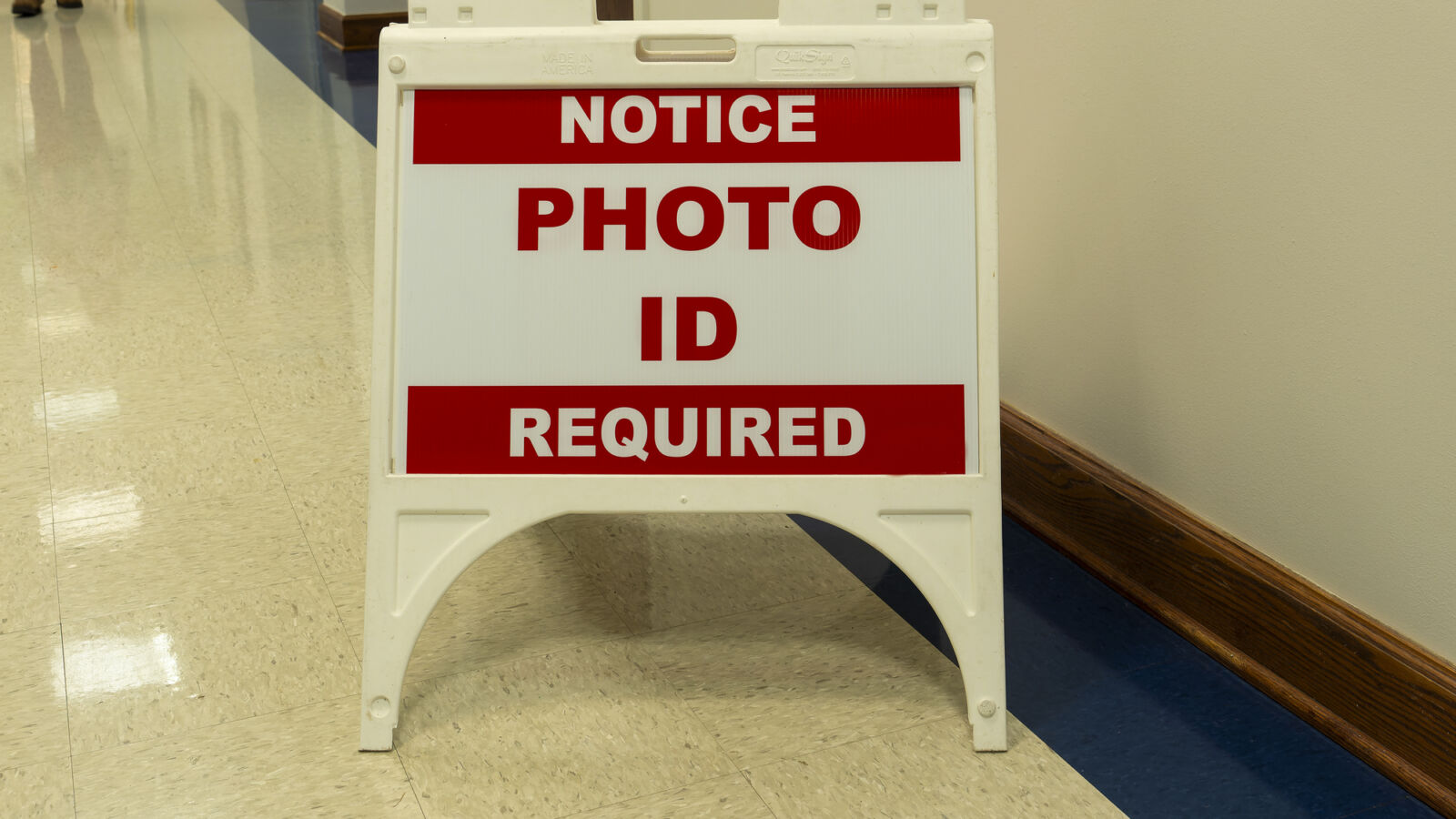
On balance, these “blue” states are less outwardly vigilant about noncitizen voting than their “red” counterparts; whether they shouldn’t be, based on the scope of the problem, is, of course, a separate question. By contrast, 15 states with Republican chief election officials have audited their rolls for noncitizens, and the country’s most surely hued red states are the likeliest to have strict voter ID laws.
To boot, the two most populous states without a voter ID statute — which also happen to be the country’s most populous and fourth-most populous states — are governed or represented by high-ranking officials who are outright antagonistic to the idea of one. California governor Gavin Newsom signed a bill in 2024 to prohibit local governments from enacting or enforcing their own voter ID measures. One of the state’s U.S. senators, Alex Padilla, called a statewide ballot initiative to require voter ID and data reporting about voter citizenship verification “another voter suppression bill.” (Sen. Adam Schiff, Padilla’s California counterpart, has been more technical in his criticism of the ballot measure.) And Chuck Schumer, the Senate Democrats’ leader from New York, has called the SAVE America Act a “plan to resurrect the old ghost of Jim Crow” (an assessment about as rational as labeling New Jersey’s voter rolls “a serious threat to national security”).
Adding up the above, there appears to be little appetite among Democratic leaders, in general, for voter-verification policies. How that might change in the future could become ripe for debate, as 44 percent of Democratic likely voters favor a voter ID requirement, nevertheless, and 52 percent favor a proof-of-citizenship requirement for registering, per our September poll. In the meantime, Trump continues to direct his supporters’ attention toward election practices in Democratic-governed areas.
“In Detroit, Philadelphia, California, and numerous other U.S. Cities and States, the results . . . will often take weeks to Rig, I mean, calculate,” he posted to his social media platform Truth Social in early October. “Voting in America is CORRUPT!!!”
Extraordinary charges, however, require extraordinary evidence. It certainly hasn’t been demonstrated in court during the last 10 years, as summarized by the Stanford-MIT Healthy Elections Project, when many jurisdictions’ election policies and administrative practices have come under Trump’s attack. Readers might remember the acronym ACORN, and charges of voter fraud against the organization — which actually did result in some criminal convictions — but that was two decades ago, not proof of a systemic election issue, and an outlier, in that ACORN-like illicit activity hasn’t been documented since. Perhaps a maxim made famous by Carl Sagan, then, takes over from here: “The absence of evidence is not evidence of absence.” American politics are an enormous, multilayered system, impossible to track in each of its nooks and crannies, and one might sense that there is where election illegalities hide.
Eventually, though, mere doubt turns to absolute doubt; it becomes a matter of the willingness to trust. There is no test, in other words, that government officials could pass to allay skepticism. Instead, certain officials are — even if not provably — inherently untrustworthy.
THIS BRINGS UP THE “CAN” part of the analysis. During the latter half of September, Declare contacted state election officials in the 17 of 21 “blue” states listed above (excepting Arizona, Michigan, New Jersey, and Oregon) that haven’t released statistics about noncitizen voting to solicit their response to our poll finding and ask if they had plans to conduct an audit. Most offices didn’t respond, and none indicated that they were undertaking a noncitizen voting audit or would. One office’s response, however, is worth quoting in full, to illustrate the challenges of communicating earnestly in response to the “evidence of absence” line of thinking. It’s from the office of Washington secretary of state Steve Hobbs, who is also the current president of the National Association of Secretaries of State:
Washington has strong processes in place that ensure voter roll integrity. When issues occur, our systems allow us to identify and resolve them swiftly.
We conduct regular cross-checks between voter registration records and data received from partner state and federal agencies to update and remove ineligible voters. Potential issues with voter registration records may be identified during regular voter roll maintenance or when individuals contact our office about their registration.
Every registration is automatically ID verified through comparisons with DOL and SSA. We also do regular comparisons to Department of Health and Social Security death data as well as the Department of Corrections data to remove voters who are no longer eligible to vote from the rolls.
It is common for election offices to check their voter data against other sources, although the specific partner agencies and sharing agreements vary by state. In my conversations with dozens of local election officials over the past few years, improved data-sharing is a common request. It also happens to be the alleged culprit for the New Jersey noncitizen voter registration issue, in the form of faulty software that incorrectly recorded customer responses for one agency before transferring them to another.
But good luck trying to “package” these details, as Hobbs’s office did, for public consumption. A fine point on it could be that election offices the country over have many ways to check a baseline of voter registration information, contained on the “federal form” that all states must use in some fashion, and there are enough steps and touch points in the process — standard “list maintenance” practices to categorize active and inactive voters and remove expired ones, voters’ own updates to their registrations, and the deterrents of federal law — to prevent mass cases of illegal voting, even if not ultrarare ones. Perhaps such a general description is insufficient. If so, then one must engage with the substance of what an office like Hobbs’s has to say.
At the very least, the Trump administration has put the legitimacy of basic, common election administration to an extreme test during the past year, dedicating an unprecedented amount of law enforcement resources to find noncitizen voting. Acting deputy attorney general Trent McCotter provided an update on its progress in late September: “In the last four weeks alone, [the Department of Justice] has charged 32 aliens with unlawful voting and registration offenses,” he said during a press conference. “Since the beginning of this administration the Department has charged 70 people with such offenses and intend to bring many more.” A Homeland Security official said around the same time that its department had made 160 related arrests, which may fall under different statutes. There is no indication that any of the arrests or charges have been for organized, as opposed to individual, offenses. And the presumption of innocence is a bedrock of criminal prosecutions.
Whether that’s “acceptable” or whether it’s “election-altering” are two distinct questions. What’s the strongest argument for voter ID and citizenship verification is another: Is it about addressing a massive vulnerability in balloting, or signaling fairness and providing peace of mind to voters? The universe of reasonable answers is reachable with voting statistics and persuasive arguments about the obligations of government. Reaching the universe of unreasonable ones, by contrast, took refueling with foolish language and make-believe, over and over and over again.