

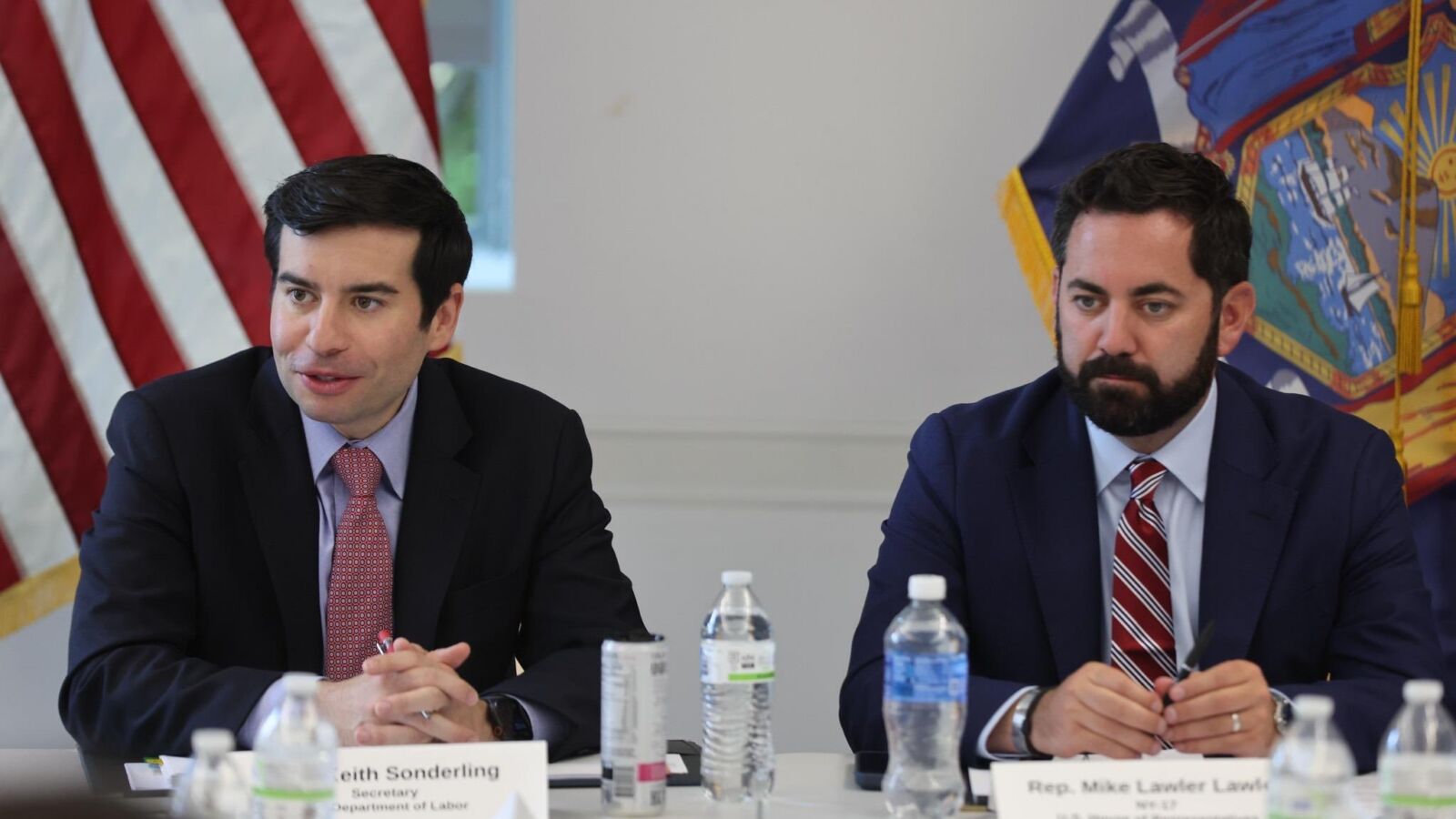
Republican congressman Mike Lawler entered Tuesday as roughly a 50/50 bet to retain his seat in the New York 17th, a swing district in the purple Hudson Valley north of the Big Apple. Elections in such territory are scrutinized for any part of the voting process that seems irregular. In this particular race, though, no stretches of the imagination or squints of the eye were necessary to allege faults in the machinery — the evidence was literally in voters’ hands.
Westchester County’s board of elections confirmed during the casting of votes on Tuesday that a programming oversight caused scanning devices to reject completed ballots at polling places across the area. Katie Miller, the wife of White House deputy chief of staff Stephen Miller and a Trump administration surrogate, amplified a social media post from someone identifying himself as a voter who experienced the issue, saying: “This is how the Left steals elections.”
Lawler, however, took a different tack. He explained, instead of exploited, the problem in multiple public appearances; encouraged voters to keep turning out; and assured the electorate that processes were in place to count every ballot. “I want to be clear: There’s no shenanigans going on here,” he said during a press availability.
Half a day later, well past nightfall, the results weren’t going his way. The machine errors in Westchester had delayed the counting of ballots cast there, but Lawler nevertheless had seen enough. “When all of the votes are counted tomorrow in Westchester, it’s gonna be pretty clear that we will be short,” he told voters at his watch party. “It’s something that I’ve never been afforded in any of my elections: a concession on election night. And I fundamentally believe it’s the right thing to do.”
I was unable to reach Lawler through his campaign on Wednesday, but my message would’ve been the same as it is here: Well done.
The same kudos, in fact, are in order for many Republican candidates who lost across the country, especially in Texas. Like Lawler, Gov. Greg Abbott, running for a fourth term, told his supporters that “mathematically, we’re not going to be able to win this election” even before the Associated Press had called it. He dialed his opponent, state rep Gina Hinojosa, to congratulate her and offer help with the transition, which Hinojosa acknowledged during her victory speech. Lieutenant Gov. Dan Patrick did Abbott one further in conceding his reelection loss, calling the election “fair.”
“This was a wave election in Texas and across the country. … I respect how the people voted,” he wrote in a statement. “It was a fair election, and I accept the majority will of the voters.”
Richard Hudson, the chairman of the National Republican Congressional Committee this cycle, lost a close race in North Carolina, but said in a statement that he called and congratulated his Democratic challenger and looked forward to a “smooth” handoff of his seat. Vivek Ramaswamy, the Republican nominee for governor in Ohio who earned wide condemnation for an attack ad featuring his opponent’s estranged mother, began to make right in his concession speech on Tuesday night.
“We are rooting for the success of this state, we’re rooting for your success, and that means that all of us in this room should be rooting for the success of her administration,” he said of the governor-elect, Amy Acton.
During the last decade, this tone of gratitude would’ve been regarded as weak among influential quarters of the right. To the contrary, it has been contesting election results mostly for the sake of “fighting” that has proven to be weak politically, as Cygnal pollster Alex Tarascio and Iowa Republican strategist David Kochel wrote last month. In addition, it is morally weak: The kind of performative display that voters eventually see for what it is.
A culture of strong character even in defeat will help produce the caliber of winners that America needs in these times of social and political upheaval.


DOJ’s Incompetence Should Concern Everyone, Republicans Included